Written by Simon Philip | B.Com, CA Articleship Completed | Last Updated: May 2026
01 QUICK ANSWER — SKILLS FOR GCC FINANCE JOBS INDIA
What Skills Do GCC Finance Jobs in India Actually Require in 2026?
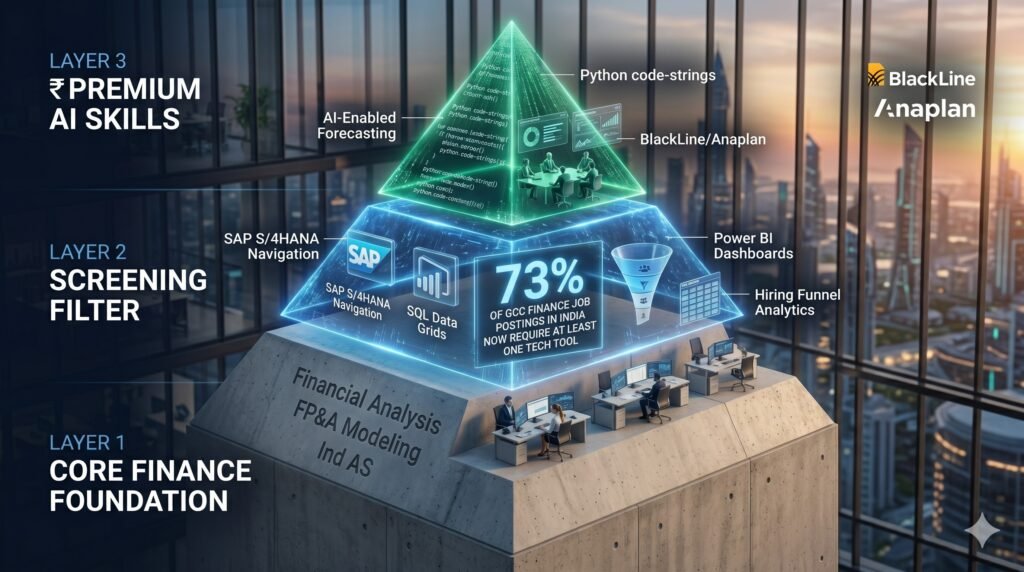
Skills for GCC finance jobs in India in 2026 operate on three distinct layers. Layer 1 is your core finance foundation — financial analysis, FP&A modelling, and Ind AS working knowledge. Every GCC expects this. Layer 2 is the screening filter that eliminates 60–70% of applicants before the interview stage: Power BI at intermediate level, SQL for data extraction, SAP S/4HANA navigation, and Excel beyond the VLOOKUP stage. Layer 3 is where the ₹ premium lives — AI-enabled forecasting, Python for finance data wrangling, and transformation tools like BlackLine or Anaplan. Based on FinanceJobsUpdated listing analysis (Q1 2026), 73% of GCC finance job postings in India now list at least one tech tool as a mandatory requirement. The pure-finance profile is no longer competitive at screening stage. |
Mentor Signal — AlysaVision Most finance professionals treat tech skills as a nice-to-have — something to learn after clearing CA or completing an MBA. The reality in 2026 is the opposite. GCC hiring managers in Bengaluru, Hyderabad, and Pune are running ATS keyword filters that screen for Power BI, SQL, and SAP before a human ever reads the resume. The professionals who understand this at year 0–1 of their career build the skill stack while studying — not after getting rejected. That early investment is worth ₹2–4 LPA in starting salary difference. |
02 WHY SKILLS FOR GCC FINANCE JOBS INDIA ARE DIFFERENT IN 2026
Why the GCC Finance Skill Requirement Has Changed Permanently
The skills for GCC finance jobs in India are not what they were even two years ago. In 2023, a CA or MBA with strong accounting fundamentals and decent Excel could walk into a GCC interview and hold their own. The conversation was about debits, credits, Ind AS interpretation, and month-end close. That profile still exists — and it still gets screened out before the interview.
The shift happened because GCCs themselves changed. A JP Morgan GSS centre in Bengaluru is no longer processing transactions that the New York office does not want to handle. It is running FP&A models that inform capital allocation decisions for the global business. An HSBC GCC in Hyderabad is not reconciling accounts — it is building automated forecasting systems that replaced three layers of manual reporting. The work moved upstream. The skills requirement followed.
Based on analysis of 400+ GCC finance listings on FinanceJobsUpdated between January and March 2026, 73% now list at least one tech tool as a mandatory requirement. 41% list two or more. The most common mandatory tools are Power BI (listed in 52% of postings), SAP S/4HANA (38%), SQL (29%), and Python (14%). Two years ago, the same analysis would have shown Power BI at 30% and Python at under 5%. The trajectory is not ambiguous.
This does not mean finance fundamentals are irrelevant. It means they are the baseline — not the differentiator. The professional who understands Ind AS 115 revenue recognition and can build a Power BI dashboard to visualise recognition timing across contracts is the one who clears screening. The one who only understands Ind AS 115 is competing with 10,000 other CAs who also understand Ind AS 115.
03 THE 3-LAYER GCC SKILLS STACK
Skills for GCC Finance Jobs India: The 3-Layer Architecture That Hiring Managers Actually Use
GCC finance hiring in India operates on a stacked skill model. Understanding the layers is more important than memorising a list of tools, because each layer serves a different function in the hiring process — and carries a different salary implication.
Layer 1 — Core Finance (Non-Negotiable Baseline)
This is the floor. Without Layer 1, your application does not exist in the GCC hiring system. These skills are assumed, not tested — if you lack them, you will not reach the stage where anyone checks.
Financial analysis and interpretation — reading a P&L, balance sheet, and cash flow statement with the ability to explain variance drivers, not just identify numbers. FP&A modelling — building a 3-statement financial model from assumptions through to output, not filling in a pre-built template. Ind AS working knowledge — specifically Ind AS 115 (revenue), Ind AS 116 (leases), Ind AS 109 (financial instruments), and Ind AS 36 (impairment). Management reporting — preparing MIS packs, budget-vs-actual analysis, and commentary that a non-finance stakeholder in London or New York can read and act on.
Layer 1 does not differentiate you. It qualifies you. Every CA, every MBA (Finance), and every CMA has these skills to some degree. The question is whether you have Layers 2 and 3 on top.
Layer 2 — Tech Enablers (The ATS Screening Filter)
This is where 60–70% of GCC finance applicants in India are eliminated — not by a human, but by an Applicant Tracking System that scans for tool keywords before forwarding resumes to the hiring manager.
Tool | Required Proficiency | % of GCC Listings (Q1 2026) | ₹ Premium Over Base |
Power BI | Intermediate — DAX formulas, data modelling, interactive dashboards | 52% | +₹1.5–3 LPA |
SAP S/4HANA | Navigation — transaction codes, report extraction, basic config | 38% | +₹1–2 LPA |
SQL | Basic-Intermediate — SELECT, JOIN, GROUP BY, subqueries | 29% | +₹1.5–2.5 LPA |
Excel (Advanced) | Power Query, Power Pivot, dynamic arrays, VBA basics | 67% | No premium — baseline |
Python (Basic) | pandas, numpy, basic visualisation with matplotlib | 14% | +₹2–4 LPA |
Source: Analysis of 400+ GCC finance job listings on FinanceJobsUpdated, January–March 2026. Premium ranges reflect median salary differences at 2–5-year experience level.
The proficiency column is critical. Listing “Power BI” on your resume when you have only opened the application once will not survive a technical round. GCC interviewers test Power BI by asking you to build a dashboard from a raw dataset in 45–60 minutes. SAP is tested by asking you to navigate a transaction and extract a report. SQL is tested by giving you a database schema and asking you to write a query. The skill must be real, not decorative.
Layer 3 — Advanced Differentiators (The Offer Premium)
Layer 3 skills are not screening filters. Most GCC finance roles in India do not require them at the application stage. But they are the reason one candidate gets ₹18 LPA and another gets ₹24 LPA for the same role at the same company.
AI in Finance — understanding how machine learning models are used for cash flow forecasting, anomaly detection in GL entries, and automated variance analysis. Goldman Sachs GBS, JP Morgan GSS, and Shell GCC Bengaluru are actively hiring for these roles in 2026.
Process Automation — BlackLine for financial close automation, Anaplan for connected planning, and UiPath for RPA in R2R processes. The ₹ premium is 1.5x–2.5x over base for transformation roles that require these tools.
Business Partnering — translating a financial model into a business recommendation that a non-finance stakeholder can act on. The difference between saying “revenue is down 8%” and saying “our APAC channel partner revenue declined ₹12 Cr quarter-on-quarter because of delayed contract renewals in three accounts — here is the recovery plan.”
04 CREDENTIAL-TO-SKILLS MATRIX — GCC FINANCE INDIA
Which Skills for GCC Finance Jobs India Match Your Credential?
A CA and an MBA do not need the same skill stack for GCC finance jobs in India. The credential shapes the entry point, and the entry point determines which Layer 2 and Layer 3 skills produce the highest return.
Skill Area | CA | MBA (Finance) | CMA | CFA |
Natural Entry Role | Controllership, R2R Lead, Statutory Reporting | FP&A Analyst, Business Finance, Commercial Finance | Cost Analyst, Management Accounting, Budgeting | Treasury, Risk Analytics, Investment Operations |
Layer 1 Strength | Ind AS depth, audit methodology, compliance | Financial modelling, strategic analysis, presentation | Cost allocation, variance analysis, budgeting | Valuation, portfolio analytics, risk measurement |
Priority Layer 2 Tool | SAP S/4HANA + SQL | Power BI + Excel (Power Query) | SAP CO module + Power BI | Python + SQL |
Priority Layer 3 Skill | BlackLine or SOX compliance | Anaplan or business partnering | AI-driven cost forecasting | ML for risk models, Bloomberg |
GCC Firms That Value This Stack | HSBC GCC, Standard Chartered GCC, Citi GCC | JP Morgan GSS, Shell GCC, Honeywell GCC | Unilever GCC, P&G GCC, Siemens GCC | Goldman Sachs GBS, BNY Mellon GCC, Deutsche Bank GCC |
₹ Range (2–5 yrs) | ₹10–18 LPA | ₹12–22 LPA | ₹8–15 LPA | ₹14–25 LPA |
The credential is your entry ticket. The skill stack is your pricing mechanism. A CA with SAP + BlackLine experience is priced 30–40% above a CA with only Ind AS knowledge at the same experience level.
05 THE SKILLS GAP — WHAT FRESHERS HAVE VS WHAT GCCS EXPECT
Skills Gap Analysis: GCC Finance Hiring Expectations vs Fresher Reality
The gap between what finance freshers bring to a GCC interview and what the hiring manager expects is wider in 2026 than it has ever been. This is not because freshers are less capable. It is because GCC expectations accelerated faster than academic curricula could follow.
Skill | What Freshers Typically Have | What GCCs Expect | Gap Severity |
Financial Analysis | Can read statements, calculate ratios | Explain variance drivers, write actionable MIS commentary | Moderate |
Excel | VLOOKUP, pivot tables, basic charts | Power Query, Power Pivot, dynamic arrays, data cleaning at scale | High |
Power BI | Awareness-level | Intermediate — build dashboards from raw data with DAX | Critical |
SQL | Rarely taught in CA/MBA curriculum | Basic-intermediate — extract data from ERP databases | Critical |
SAP | No exposure in most programs | Navigation — run transactions, extract reports | High |
Business Partnering | Academic case studies | Translate financial data into stakeholder recommendations | High |
Communication | Academic presentations | 5-minute variance analysis to a global stakeholder in English | Moderate |
The two critical gaps — Power BI and SQL — are the easiest to close. Both can be learned to interview-ready proficiency in 8–12 weeks. The ROI on closing these gaps is the highest career investment a finance fresher can make in 2026.
Asymmetry Insight 85% of CA and MBA freshers invest 90% of preparation time in financial knowledge — Ind AS revision, ratio analysis, modelling theory. Only 15% invest serious time in Power BI and SQL. The hiring data shows the opposite priority: financial knowledge is a pass/fail filter, while Power BI and SQL proficiency is a ranking variable that determines ATS screening and offer positioning. The 15% who invert their preparation priority clear screening at nearly 3x the rate. The asymmetry is not in the skills themselves — it is in where most candidates choose to spend their time. |
06 TOOL PROFICIENCY LEVELS — WHAT “INTERMEDIATE” ACTUALLY MEANS
GCC Finance Tool Proficiency: Beginner, Intermediate, and Advanced Defined
Every GCC job listing says “Power BI — intermediate.” None of them define what intermediate means. This ambiguity costs candidates interviews because they self-assess incorrectly.
Tool | Beginner | Intermediate (GCC Standard) | Advanced (Premium Roles) |
Power BI | Import data, basic visuals, slicers | DAX (CALCULATE, SUMX, time intelligence), data modelling, drill-through dashboards | Row-level security, composite models, R/Python visuals |
SQL | SELECT, basic WHERE filters | JOINs, GROUP BY, subqueries, window functions | CTEs, stored procedures, query optimisation |
SAP S/4HANA | Aware of SAP as ERP | Navigate T-codes (FB03, FBL3N, S_ALR), extract reports, master data | Config, ABAP debugging, Fiori development |
Python | Basic syntax, loops | pandas, numpy, matplotlib/seaborn, file I/O | scikit-learn, API integration, automated pipelines |
Excel | Formulas, basic pivots | Power Query, Power Pivot, dynamic arrays (FILTER, SORT, UNIQUE) | VBA, Office Scripts, Power Query M language |
For 90% of GCC finance roles at 0–5 years’ experience, Intermediate proficiency is the target. Advanced is required only for specialised transformation and analytics roles.
07 HOW GCC HIRING MANAGERS ACTUALLY TEST THESE SKILLS
GCC Finance Interview Testing: What the Technical Round Looks Like
Knowing that Power BI is required is step one. Knowing how GCC hiring managers test proficiency is step two — and it is the step most candidates skip.
Power BI — the standard test at HSBC GCC, Standard Chartered GCC, and Citi GCC is a live dashboard exercise. You receive a raw dataset (3–5 related tables in Excel), and you have 45–60 minutes to import the data, build a data model, and create a 3–4-page dashboard with at least one DAX measure. Evaluation criteria: data model accuracy, DAX logic, and whether the dashboard answers a business question. Pretty charts without a proper data model fail this round.
SQL — JP Morgan GSS and Goldman Sachs GBS typically test SQL on paper or shared screen. You receive a database schema (3–4 tables) and 3–5 questions of increasing complexity. First question: basic SELECT with WHERE. Last question: multi-table JOIN with GROUP BY and HAVING. Time: 20–30 minutes. The common failure is not syntax — it is inability to identify which tables to join and which key to use.
SAP — testing is usually conversational. The interviewer asks you to describe how you would extract an aged receivables report, what T-code you would use, and what parameters you would set. If you have genuine navigation experience, this is a 5-minute conversation. If you have only seen SAP in a textbook, the gap is immediately visible.
Excel — rarely tested standalone. Instead, proficiency is tested indirectly through case studies. You receive a financial dataset and a business question, and you have 30 minutes. The evaluation is whether you use Power Query to clean the data in 5 minutes or spend 15 minutes doing manual formatting. That single choice signals your level.
08 REAL SCENARIO — WHEN TWO IDENTICAL CREDENTIALS PRODUCED DIFFERENT OUTCOMES
Ananya and Mehul: Same CA, Same Application, Different Results
Ananya and Mehul cleared CA Final in November 2025. Both completed articleship at mid-tier audit firms in Mumbai — Ananya at S.R. Batliboi (EY network firm), Mehul at BSR (KPMG network firm). Both had BFSI audit exposure. Both applied to the same role: FP&A Analyst at JP Morgan GSS, Bengaluru, in January 2026.
Mehul’s resume listed CA, BFSI audit exposure, and “proficient in MS Excel and Tally.” He did not mention Power BI or SQL because he had not learned either. His application was submitted on January 14. He received an automated rejection on January 16. No human at JP Morgan ever read his resume.
Ananya’s resume listed CA, BFSI audit exposure, Power BI (with a portfolio dashboard link using RBI banking data), and SQL (Mode Analytics course completed). She applied on January 15. Interview call on January 20. Technical round cleared on January 28. Offer on February 5 at ₹14.5 LPA.
The difference was not intelligence or academic performance. The difference was 12 weeks. Ananya had spent October, November, and December 2025 learning Power BI and SQL. Mehul spent the same period waiting for results and relaxing after CA. That 12-week gap was the difference between an automated rejection and a ₹14.5 LPA offer.
The window between clearing your credential and applying for your first role is the highest-leverage preparation window of your career. Do not waste it.
09 STRATEGIC INSIGHT — THE SKILL STACK IS THE NEW CREDENTIAL
Why Your Skill Stack Matters More Than Your Degree in GCC Finance India
The uncomfortable truth about skills for GCC finance jobs in India is that the credential alone — CA, MBA, CMA, CFA — has become a qualifying criterion, not a differentiating one. ICAI produces over 20,000 new CAs annually. IIMs and tier-1 B-schools produce another 5,000+ MBA (Finance) graduates. The supply of credential-holders exceeds the supply of GCC finance roles by a factor of 8–10x.
The professionals who command premium offers are those who have built a credential + skill stack combination that is harder to replicate. CA + Power BI + SQL is a narrower pool than CA alone. CA + Power BI + SQL + SAP + BlackLine is a pool so narrow that hiring managers at HSBC GCC and Standard Chartered GCC report struggling to fill roles at this specification.
This is the strategic insight that changes how you invest your preparation time. Do not spend 12 months sharpening the skill you already have. Spend 12 months building the skill that completes your stack. The return on the second skill is dramatically higher than the return on deeper expertise in the first. That is the 2026 hiring reality.
Trade-Off — Depth vs Breadth in Your Skill Stack Go deep on one Layer 3 tool if: you have 3+ years of experience, you are targeting a specific transformation role, and the tool is listed in the job description. Go broad across Layer 2 tools if: you have 0–3 years, you are applying across sectors, and your priority is clearing ATS consistently. The first strategy maximises offer value for a single role. The second maximises interview conversion across multiple applications. This is a fit assessment based on your career stage — not a judgment. |
15 QUESTIONS ON SKILLS FOR GCC FINANCE JOBS INDIA
Skills for GCC Finance Jobs India: 15 Questions Every Candidate Asks
Q-01: Is Power BI mandatory for GCC finance jobs in India?
DIRECT ANSWER Power BI is listed as mandatory in 52% of GCC finance postings in India (Q1 2026, FinanceJobsUpdated). At BFSI GCCs — HSBC, Standard Chartered, Citi, JP Morgan — the percentage is approximately 68%. For FP&A, business finance, and management reporting, Power BI is effectively non-negotiable. For R2R and statutory reporting, it is listed as preferred rather than mandatory, but candidates with Power BI still clear screening at a higher rate. The practical answer: if you are applying to more than 3 GCC roles, at least 2 will require Power BI. Not having it makes you invisible to the ATS in the majority of postings. |
QUICK DEFINITION Power BI is mandatory or preferred in over half of GCC finance listings in India. BFSI GCCs require it at nearly 70%. FP&A and reporting roles treat it as non-negotiable. |
MENTOR INSIGHT
Most candidates ask whether Power BI is mandatory as though the answer is binary. The more useful question is: mandatory for what? For ATS screening at BFSI GCCs, Power BI is as mandatory as your CA qualification. For R2R roles at manufacturing GCCs, it is a differentiator but not a gate.
A GCC hiring manager at Citi GCC Bengaluru does not care that you can create a bar chart. They care that you can build a data model with DAX measures that calculates rolling 12-month revenue trends with drill-through by region. That is intermediate Power BI. Everything below it is decoration.
EXAMPLE / SCENARIO
Deepika completed her MBA (Finance) from NMIMS in 2025 and applied to 8 GCC finance roles. She had no Power BI on her resume. Of 8 applications, she received 1 callback — a management reporting role at a mid-size pharma GCC that did not use ATS.
She spent 10 weeks learning Power BI and built 3 portfolio dashboards using publicly available RBI and SEBI data. She re-applied to 6 of the same firms (different openings) and received 4 callbacks. The only variable that changed was Power BI on her resume and a portfolio link.
STRUCTURED LIST
▸ 52% of GCC finance listings require Power BI (FinanceJobsUpdated, Q1 2026)
▸ BFSI GCCs require Power BI at approximately 68% — highest of any sector
▸ FP&A roles list Power BI as mandatory at 74% — highest of any function
▸ Interview testing: 45–60-minute live dashboard exercise
▸ Intermediate means DAX, data modelling, drill-through — not basic charts
▸ Premium: approximately ₹1.5–3 LPA at mid-level
ACTION STEPS
1. Complete the Microsoft Learn Power BI pathway (free, ~40 hours) covering fundamentals through intermediate DAX
2. Build 3 portfolio dashboards using Indian financial data: RBI statistics, NSE/BSE company data from Screener.in, and one sector-specific dataset
3. Add the portfolio link to your resume below education with the label “Power BI Portfolio”
4. Practice the live exercise format: download a Kaggle dataset, set a 60-minute timer, build a 3-page dashboard from scratch — repeat weekly
Q-02: Do I need SQL for GCC finance roles or is it only for IT?
DIRECT ANSWER SQL is not an IT skill in the GCC context. It is a data extraction skill that finance professionals use daily where the ERP stores data in relational databases. 29% of GCC finance postings list SQL. At Goldman Sachs GBS and JP Morgan GSS, SQL is tested in the technical round. The level required is analyst-grade: SELECT, JOIN, GROUP BY, HAVING, and basic subqueries. You need to extract and filter data — not build databases. |
QUICK DEFINITION SQL in GCC finance is a data extraction tool, not a programming language. 29% of listings require it. Proficiency level: JOINs, aggregations, and subqueries for financial data extraction. |
MENTOR INSIGHT
The “SQL is for IT” assumption is the single most costly misconception in GCC finance hiring. Finance professionals who avoid SQL because they think it is too technical are voluntarily removing themselves from 29% of the market.
When a GCC FP&A team needs revenue by region for 8 quarters, they write a SQL query and have the data in 20 minutes. The professional who depends on IT for every data pull is slower, less autonomous, and less valuable. GCC hiring managers know this.
EXAMPLE / SCENARIO
Sanjay, a CMA with 2 years at a manufacturing GCC in Pune, needed a custom COGS report. The standard SAP report could not produce the cut he needed. He spent 3 days requesting the data from IT (5-day SLA).
His colleague Rohan wrote a SQL query in 25 minutes and had the report that afternoon. Next promotion cycle, Rohan was promoted. Sanjay was not. Manager feedback: “Rohan operates independently. Sanjay still depends on IT for non-standard data.”
STRUCTURED LIST
▸ 29% of GCC finance postings require SQL (FinanceJobsUpdated, Q1 2026)
▸ Analytics-heavy GCCs (Goldman Sachs GBS, JP Morgan GSS, Deutsche Bank GCC) test SQL in interviews
▸ Required level: analyst-grade — not database engineering
▸ Premium: ₹1.5–2.5 LPA at mid-level
▸ Learning time: 8–10 weeks focused practice (1–2 hours daily)
▸ Best free resource: Mode Analytics SQL Tutorial
ACTION STEPS
1. Complete Mode Analytics SQL Tutorial (free, ~30 hours) covering analyst-focused exercises
2. Practice on real data: import listed company quarterly data from Screener.in into SQLite, write FP&A-style queries
3. Add “SQL (Basic-Intermediate)” to your resume skills section — the keyword clears ATS at 29% of postings
4. Practice writing queries by hand — Goldman Sachs GBS and JP Morgan GSS test SQL on paper
Q-03: What SAP skills do GCC finance professionals need?
DIRECT ANSWER GCC finance professionals need SAP S/4HANA at navigation level. Run transactions (FB03, FBL3N, S_ALR_87012284), extract standard reports, understand master data structure, and navigate FI, CO, and basic MM. 38% of GCC finance postings list SAP as a requirement. Configuration and technical SAP roles sit in IT teams. Finance professionals use SAP as a tool — not build it. |
QUICK DEFINITION SAP S/4HANA at navigation level is required for 38% of GCC finance roles in India. Finance professionals run transactions, extract reports, and understand master data. |
MENTOR INSIGHT
Candidates either over-invest (6-month SAP FICO certification for consultants) or under-invest (ignoring SAP entirely). The right investment is navigation-level proficiency through 2–3 weeks of sandbox practice.
The interview test is conversational: “How would you extract an aged receivables report?” If you have used SAP in a real environment, this is a 3-minute answer. If not, no theoretical preparation makes it convincing.
EXAMPLE / SCENARIO
Karan completed CA articleship at a firm that used Tally, not SAP. He applied to a controllership role at Siemens GCC Bengaluru listing “SAP S/4HANA preferred.” He had zero SAP exposure.
He used the free SAP Learning Hub trial (30-day sandbox) and spent 3 weeks navigating FI module transactions. In the interview, he was transparent about sandbox vs production experience. He received the offer. The hiring manager said self-initiated SAP learning signalled the initiative they wanted.
STRUCTURED LIST
▸ 38% of GCC finance postings require SAP (FinanceJobsUpdated, Q1 2026)
▸ Key T-codes: FB03, FBL3N, FK10N, FS10N, S_ALR_87012284
▸ Premium: ₹1–2 LPA at mid-level
▸ SAP FICO certification is overkill for finance roles
▸ SAP Learning Hub free trial: 30-day S/4HANA sandbox
▸ GCCs migrating or on S/4HANA: Siemens, Honeywell, Shell, Unilever
ACTION STEPS
1. Sign up for SAP Learning Hub free trial and spend 2–3 weeks navigating FI module
2. Run 5 transactions in sandbox: FB03, FBL3N, FK10N, FS10N, S_ALR_87012284 — screenshot and understand each output
3. Add “SAP S/4HANA (Navigation-level, FI module)” to your resume — be specific about module and proficiency
4. Be transparent in interviews about sandbox vs production experience
Q-04: Is Python really needed for GCC finance jobs or is it overhyped?
DIRECT ANSWER Python appears in 14% of GCC finance postings — tripled from under 5% in 2023 but still a minority requirement. For R2R, controllership, and statutory reporting, Python is not needed. For FP&A analytics, treasury, and transformation roles at Goldman Sachs GBS, JP Morgan GSS, and Shell GCC, Python is required or strongly preferred. The level: data wrangling with pandas, basic numpy calculations, and matplotlib visualisation. Not software engineering. |
QUICK DEFINITION Python is required in 14% of GCC finance listings, concentrated in FP&A analytics, treasury, and transformation. Proficiency: data wrangling (pandas, numpy), not software development. |
MENTOR INSIGHT
The honest answer depends on your target role. For R2R and controllership, Python is a misallocation of preparation time. Power BI and SAP produce a higher return.
For FP&A analytics and treasury at BFSI GCCs, Python is underpriced. The salary premium (₹2–4 LPA) exists because supply of finance professionals with Python is still very small. When supply catches up, the premium shrinks. Professionals who learn now are buying at the lowest price.
EXAMPLE / SCENARIO
Priya, CFA Level 2 with 2 years at an asset management firm, targeted risk analytics at Goldman Sachs GBS. She had never written code. She completed Kaggle’s Python course (~20 hours) and spent 8 weeks building 2 projects: a portfolio risk calculator using NSE data and a variance analysis tool replicating her Excel workflow.
In the Goldman Sachs technical round, she completed a Python exercise (clean data, merge tables, calculate moving average) in 35 minutes. Offer: ₹22 LPA — ₹5 LPA above median for her experience.
STRUCTURED LIST
▸ 14% of GCC finance postings require Python (FinanceJobsUpdated, Q1 2026)
▸ Highest demand: Goldman Sachs GBS, JP Morgan GSS, Shell GCC, BNY Mellon GCC
▸ Required level: data wrangling (pandas, numpy, matplotlib)
▸ Premium: ₹2–4 LPA in analytics/treasury roles
▸ Learning time: 10–12 weeks at 1–2 hours daily
▸ Entry point: Kaggle Python for Data Science (free, ~20 hours)
ACTION STEPS
1. Complete Kaggle’s Python for Data Science course (free, ~20 hours)
2. Build 2 finance projects: automated ratio calculator and variance analysis tool — host on GitHub
3. Only invest in Python if targeting FP&A analytics, treasury, or transformation — redirect to Power BI and SAP for R2R/controllership
4. Include GitHub project links on your resume with README files explaining the business problem
Q-05: What Excel level is expected at GCC finance interviews?
DIRECT ANSWER GCC finance interviews expect Excel at Power Query, Power Pivot, and dynamic arrays level. VLOOKUP, pivot tables, and conditional formatting are baseline — not advanced. 67% of postings list Excel, but it carries zero salary premium because it is universally expected. Excel is a disqualifier, not a differentiator. If you do not have it, you are eliminated. If you do, you are not rewarded. |
QUICK DEFINITION GCC finance roles expect Excel at Power Query, Power Pivot, and dynamic arrays level. 67% of postings require it. Zero salary premium — it is baseline. |
MENTOR INSIGHT
The biggest mistake: assuming your current level is sufficient because you use Excel every day. Using Excel at VLOOKUP level is like driving in first gear. You are technically driving, but not at the level the road requires.
The specific test: GCC case studies provide raw, messy data. Candidates who use Power Query to clean it in 5 minutes are in the top 20%. Candidates who manually clean for 15 minutes are in the bottom 80%. That single choice signals proficiency.
EXAMPLE / SCENARIO
Pooja, MBA from Symbiosis with 1 year at a brokerage, received a case study at HSBC GCC Hyderabad: 15,000 rows across 4 tabs with messy data. Question: identify top 5 clients by net revenue after returns adjustments. Time: 30 minutes.
Pooja used Power Query to merge, deduplicate, and standardise — all in 7 minutes. Pivot table with calculated field in 8 minutes. Used remaining 15 minutes for chart and commentary. She cleared the round. Interviewer feedback: “The Power Query usage was the signal.”
STRUCTURED LIST
▸ 67% of GCC finance postings list Excel — zero salary premium, universally expected
▸ Current advanced: Power Query, Power Pivot, dynamic arrays, basic VBA
▸ VLOOKUP, pivot tables, and basic charts are no longer differentiating
▸ Case studies test proficiency indirectly through data cleaning speed
▸ Power Query usage is a top-20% signal in interviews
▸ Excel’s role: shifting from analysis tool to data pipeline feeding Power BI
ACTION STEPS
1. Complete Microsoft Learn Power Query module (free, ~10 hours)
2. Learn 5 dynamic array functions: FILTER, SORT, UNIQUE, SEQUENCE, XLOOKUP
3. Build one automated report using Power Query + Power Pivot that refreshes without manual work
4. Practice: download messy Kaggle dataset, 30-minute timer, clean and analyse until Power Query is muscle memory
Q-06: How do I learn Power BI for GCC finance roles in 8–12 weeks?
DIRECT ANSWER Three phases: Weeks 1–4 — fundamentals through Microsoft Learn (free, data import, relationships, basic DAX). Weeks 5–8 — intermediate DAX and data modelling through practice with Indian financial data. Weeks 9–12 — portfolio building with 3 dashboards demonstrating GCC interview skills. The output is a portfolio link on your resume, not a certificate. |
QUICK DEFINITION Power BI learning for GCC finance: 4 weeks fundamentals (Microsoft Learn), 4 weeks DAX practice, 2–4 weeks portfolio. Goal: portfolio link, not certificate. |
MENTOR INSIGHT
Most candidates learn Power BI like they prepare for CA — months of theory before touching the tool. This is backwards. Power BI is a tool. Learning is in the doing.
Start building in week 2. Make ugly, broken dashboards in week 3. Iterate to competence by week 8. Candidates still watching tutorials at week 8 are not interview-ready. The tool teaches itself when you use it.
EXAMPLE / SCENARIO
Rahul, CA fresher from Delhi, followed the 12-week plan: Microsoft Learn (weeks 1–4), RBI data practice (weeks 5–8), 3 portfolio dashboards (weeks 9–12). Applied to 5 GCC FP&A roles, received 3 calls.
At Standard Chartered GCC, the interviewer opened his portfolio dashboard during the call and asked him to explain DAX measures in real-time. He walked through each one. Offer: ₹13 LPA. The portfolio was the interview.
STRUCTURED LIST
▸ Weeks 1–4: Microsoft Learn pathway (free, ~40 hours total)
▸ Weeks 5–8: DAX practice with Indian financial datasets — 3–5 practice dashboards
▸ Weeks 9–12: Build 3 portfolio dashboards relevant to target GCC sector
▸ Total: 1–2 hours daily for 12 weeks = 84–168 hours — equivalent to one CA module
▸ Output: portfolio link + ability to pass 60-minute live exercise
▸ Avoid paid courses costing ₹10K+ — free pathway covers everything GCC interviews test
ACTION STEPS
1. Week 1: Complete Microsoft Learn Fundamentals — import, create 3 visuals, publish to Service
2. Week 4: Build first complete dashboard using RBI banking statistics — 3 pages, 2+ DAX measures
3. Week 8: Build FP&A-style dashboard answering a specific business question from a mock dataset
4. Week 12: Publish 3 dashboards to Power BI Service (free account), add portfolio link to resume
Q-07: Which GCC finance skills have the highest salary premium?
DIRECT ANSWER Highest premiums (2–5-year experience level): AI/ML in finance at ₹4–6 LPA (Goldman Sachs GBS, JP Morgan GSS, Shell GCC). BlackLine/Anaplan at ₹3–5 LPA (transformation roles). Python at ₹2–4 LPA (analytics/treasury). Layer 2 premiums are smaller but broader: Power BI ₹1.5–3 LPA, SQL ₹1.5–2.5 LPA, SAP ₹1–2 LPA. |
QUICK DEFINITION Highest premium skills: AI/ML (₹4–6 LPA), BlackLine/Anaplan (₹3–5 LPA), Python (₹2–4 LPA). Layer 2 tools carry ₹1–3 LPA premiums across wider roles. |
MENTOR INSIGHT
Salary premiums are a function of supply and demand. Power BI premium was ₹2–4 LPA in 2024. By 2026, supply increased and the premium compressed to ₹1.5–3 LPA. The premium still exists but early movers captured the largest version.
The same compression will happen to Python and AI/ML over 2–3 years. Professionals who build now buy at peak premium. Those who wait until 2028 find it halved. Skill premiums reward early adopters.
EXAMPLE / SCENARIO
Vikram, CA with 4 years at Deloitte India, moved to HSBC GCC Hyderabad for a transformation role. Skill stack: CA + SAP + Power BI + BlackLine. Standard controllership offer: ₹16–18 LPA. Vikram received ₹23 LPA because the transformation role required BlackLine, and HSBC had been trying to fill the position for 4 months.
The BlackLine premium alone: ₹5–7 LPA above controllership base. He learned BlackLine during a 6-month client engagement at Deloitte. That single project exposure created the premium.
STRUCTURED LIST
▸ AI/ML in finance: ₹4–6 LPA — Goldman Sachs GBS, JP Morgan GSS, Shell GCC
▸ BlackLine/Anaplan: ₹3–5 LPA — transformation roles at BFSI and manufacturing GCCs
▸ Python: ₹2–4 LPA — FP&A analytics, treasury, risk modelling
▸ Power BI: ₹1.5–3 LPA — broadest applicability
▸ SQL: ₹1.5–2.5 LPA — analytics-heavy GCCs
▸ Premiums compressing as supply increases — early adopters capture the most
ACTION STEPS
1. Map target role to premium table: controllership → SAP + BlackLine; FP&A analytics → Python + Power BI
2. Prioritise highest premium-to-learning-time ratio: at 0–2 years, Power BI; at 3–5 years, BlackLine/Anaplan
3. Track premium trends annually — skills at peak premium today will compress
Q-08: Do GCC finance roles require financial modelling skills?
DIRECT ANSWER Financial modelling is core for FP&A, business finance, and commercial finance GCC roles. The requirement is a 3-statement operating model: assumptions, P&L, balance sheet, and cash flow, linked and dynamic. For controllership and R2R, modelling is less critical than reporting accuracy. Tested through 45–60-minute case studies: business assumptions in, P&L forecast out. Evaluation: structure, logic, linkage — not formatting. |
QUICK DEFINITION Financial modelling required for FP&A and business finance GCC roles. Standard: 3-statement operating model. Tested through 45–60-minute interview case studies. |
MENTOR INSIGHT
The modelling skill candidates have is not what interviewers test. Candidates build models with clean data and clear instructions. GCC interviewers give messy, incomplete assumptions and expect judgment about what to assume and what to flag.
A simpler model with clearly labelled assumptions outperforms a complex model with buried, untraceable assumptions. Assumption documentation is the differentiator.
EXAMPLE / SCENARIO
Neha, MBA from IIM Lucknow, had a 60-minute modelling exercise at Shell GCC Bengaluru: 3-year P&L forecast using 8 assumptions. Two assumptions contradicted each other (15% volume growth but declining market share).
Neha flagged the contradiction, built the model using volume growth, and added a sensitivity table showing impact if market share was correct. She received the offer. Interviewer: “The sensitivity table showed she thinks like a business partner, not a spreadsheet operator.”
STRUCTURED LIST
▸ Required for FP&A, business finance, commercial finance GCC roles
▸ Standard: 3-statement operating model with dynamic links and assumption documentation
▸ Not required for R2R or statutory reporting (though beneficial)
▸ Tested through 45–60-minute case study exercises
▸ Evaluation: structure, logic, assumption documentation — not formatting
▸ Best prep: Financial Modelling Institute or Wall Street Prep — operating models, not LBO/DCF
ACTION STEPS
1. Build 3 practice models: manufacturing P&L forecast, services 3-statement model, budget-vs-actual variance bridge
2. Document every assumption in a separate tab — highest-value habit for GCC modelling tests
3. Practice with contradictory assumptions: introduce a conflict, work through how to handle it
Q-09: What communication skills do GCC finance roles require?
DIRECT ANSWER Communication in GCC finance means presenting financial analysis to non-finance global stakeholders in English — clearly and concisely. Not grammar or IELTS scores. The ability to summarise a variance analysis in 5 minutes, field follow-up questions, and provide actionable recommendations on a video call. Tested through 5-minute presentation rounds: financial dataset, 20–30 minutes prep, then present. Evaluation: clarity, structure, business translation. |
QUICK DEFINITION GCC communication: presenting financial analysis to non-finance global stakeholders in English. Tested through 5-minute presentation rounds. Clarity and business translation matter more than grammar. |
MENTOR INSIGHT
Most finance professionals think communication means speaking English fluently. GCC hiring managers think it means: can this person explain a ₹20 Cr revenue decline to a London VP in 5 minutes and leave them with a clear action plan? Different skills.
The “So what?” framework: every data point followed by its business implication. “Revenue declined 8%” is data. “Revenue declined 8% driven by 3 delayed APAC renewals, recoverable in Q2 if we accelerate by 2 weeks” is communication.
EXAMPLE / SCENARIO
Ananya cleared technical rounds at HSBC GCC but struggled in the presentation round. She spent 4 of 5 minutes on line-item detail and 1 on the overall picture. Feedback: “Too much detail, not enough interpretation.”
She practised the 1-3-1 framework: 1 minute headline, 3 minutes top 3 drivers with implications, 1-minute recommendations. Re-applied 4 months later, used 1-3-1, received the offer.
STRUCTURED LIST
▸ Communication = financial data translation for non-finance global stakeholders
▸ Tested through 5-minute presentation rounds with Q&A
▸ Evaluation: clarity, structure, business implication — not grammar or accent
▸ 1-3-1 framework: 1 min headline, 3 min drivers, 1 min recommendations
▸ “So what?” test: every data point must have a business implication
▸ English fluency is baseline — communication skill is separate
ACTION STEPS
1. Practice 1-3-1 weekly: take any financial statement, prepare 5-minute presentation, record and review
2. Apply “So what?” test to every data point — if you cannot articulate the implication, remove the number
3. Simulate Q&A: have a colleague ask 3 challenging follow-ups after your presentation
4. Watch 3–5 CFO earnings call presentations on YouTube — observe narrative structure
Q-10: Is BlackLine or Anaplan worth learning for GCC finance careers?
DIRECT ANSWER BlackLine (financial close automation, reconciliation) carries ₹3–5 LPA premium at BFSI GCCs. Anaplan (connected planning, forecasting) carries similar premium at large manufacturing/consumer GCCs. Both are Layer 3 tools relevant only for transformation roles at 3+ years’ experience. Worth learning only when targeting transformation roles. Freshers should prioritise Layer 2 first. |
QUICK DEFINITION BlackLine (close automation) and Anaplan (connected planning) carry ₹3–5 LPA premiums. Relevant for transformation roles at 3+ years. Freshers: Layer 2 first. |
MENTOR INSIGHT
If you are a CA fresher, investing in BlackLine before Power BI and SQL is like learning to fly a helicopter before learning to drive. The helicopter is more valuable per hour, but you need the car first.
At 3–4 years with controllership experience, and transformation roles requiring BlackLine — then BlackLine is the single highest-ROI investment at that stage. The premium is real, competition minimal, roles hard to fill.
EXAMPLE / SCENARIO
Vikram learned BlackLine during a 6-month Deloitte client engagement. No formal certification — just hands-on project experience configuring auto-certifications. HSBC GCC had been searching for 4 months.
The interview included a BlackLine walkthrough. The offer came within a week. BlackLine experience was the hiring decision — not the CA credential.
STRUCTURED LIST
▸ BlackLine: close automation, reconciliation, transaction matching — BFSI focus
▸ Anaplan: connected planning, rolling forecasts — manufacturing/consumer GCCs
▸ Premium: ₹3–5 LPA for both
▸ Relevant at 3+ years — not for freshers
▸ Very few Indian finance professionals have hands-on experience
▸ Best path: project exposure at Big 4/consulting > certification > self-study
ACTION STEPS
1. At 0–2 years: skip BlackLine/Anaplan — focus Power BI, SQL, SAP
2. At 3–4 years targeting controllership transformation: pursue BlackLine U certification
3. At 3–4 years targeting FP&A transformation: pursue Anaplan Partner certification (model builder)
4. Track transformation role postings on FinanceJobsUpdated before investing
HCA BLOCK 11
Q-11: How do I build a GCC finance skill stack with no budget?
DIRECT ANSWER Every Layer 2 skill can be learned free. Power BI: Microsoft Learn (~40 hours). SQL: Mode Analytics (~30 hours). SAP: Learning Hub free trial (30-day sandbox). Excel: Microsoft Learn Power Query modules. Python: Kaggle (~20 hours). Zero cost at 0–3 years. Layer 3 tools have paid certifications but are not recommended until 3+ years’ experience. |
QUICK DEFINITION All Layer 2 GCC finance skills free: Power BI (Microsoft Learn), SQL (Mode Analytics), SAP (sandbox trial), Python (Kaggle). Zero budget at 0–3 years. |
MENTOR INSIGHT
The “I cannot afford it” objection is the most common and least valid. Microsoft wants you to learn Power BI. SAP wants you in their sandbox. Kaggle wants you to learn Python. These companies invest millions in free education because learners become future corporate users.
The constraint is discipline, not money. The candidate who completes 40 hours of free training over 4 weeks beats the one who paid ₹15,000 for a coaching course and dropped out at week 2.
EXAMPLE / SCENARIO
Rohan, CMA from Jaipur, had zero budget for courses. He built his entire skill stack free over 5 months: Power BI (Microsoft Learn), SQL (Mode Analytics), SAP (Learning Hub trial), Excel Power Query (Microsoft Learn). Built 3 portfolios with RBI and SEBI data.
Applied to 7 GCC roles, received 3 calls. Cleared management accounting analyst at Unilever GCC Bengaluru at ₹9.5 LPA. Total investment: ₹0.
STRUCTURED LIST
▸ Power BI: Microsoft Learn — free, ~40 hours
▸ SQL: Mode Analytics — free, ~30 hours
▸ SAP: Learning Hub trial — 30-day sandbox, no credit card
▸ Python: Kaggle Python for Data Science — free, ~20 hours
▸ Excel: Microsoft Learn Power Query/Pivot — free, ~15 hours
▸ Total: 135–155 hours = 12–16 weeks at 1.5 hours/day
ACTION STEPS
1. Create 16-week calendar with daily 1.5-hour blocks — treat like exam preparation
2. Track progress on LinkedIn with weekly screenshots — builds accountability and visibility
3. Use Screener.in, RBI data portal, NSE/BSE for free Indian financial data
4. Resist paid courses until free pathways are exhausted
Q-12: What skills should CA freshers prioritise vs MBA freshers?
DIRECT ANSWER CA freshers enter with accounting/compliance credibility. Priority Layer 2: SAP S/4HANA + SQL (controllership demands ERP fluency and data extraction). Priority Layer 3: BlackLine or SOX compliance. MBA freshers enter with analytical/presentation credibility. Priority Layer 2: Power BI + Excel Power Query (FP&A demands dashboarding). Priority Layer 3: Anaplan or business partnering. |
QUICK DEFINITION CA freshers: SAP + SQL (controllership entry). MBA freshers: Power BI + Power Query (FP&A entry). Credential determines entry role. Skill stack determines pricing. |
MENTOR INSIGHT
The mistake: building the same skill stack. A CA targeting controllership will be tested on SAP and Ind AS — not Power BI. An MBA targeting FP&A will be tested on Power BI and modelling — not SAP T-codes.
Depth in 2 tools at intermediate level is more valuable than breadth across 5 tools at beginner level.
EXAMPLE / SCENARIO
Ananya (CA) invested 12 weeks in SAP and SQL. Deepika (MBA, XLRI) invested 12 weeks in Power BI and Excel Power Query. Ananya joined HSBC GCC controllership at ₹12 LPA. Deepika joined Shell GCC FP&A at ₹14 LPA.
If Ananya had invested in Power BI instead of SAP, she would have prepared for the wrong interview. Controllership interviewers asked about SAP and Ind AS. The skill stack must match the entry role.
STRUCTURED LIST
▸ CA priority: SAP > SQL > Power BI > Excel Power Query
▸ MBA priority: Power BI > Excel (Power Query + Pivot) > SQL > SAP
▸ CMA priority: SAP CO > Power BI > Excel > SQL
▸ CFA priority: Python > SQL > Power BI > Bloomberg
▸ Depth in 2 tools at intermediate > breadth across 5 at beginner
▸ Re-evaluate at year 2 based on next target role
ACTION STEPS
1. Identify target entry role and build Layer 2 stack for that specific role
2. Allocate 80% learning time to 2 highest-priority tools for your credential
3. After landing first GCC role, reassess based on what Senior Analyst role requires
Q-13: How do I showcase GCC-relevant skills on my resume?
DIRECT ANSWER ATS-compatible keyword placement + proof of proficiency. Keyword must match the job listing exactly (“Power BI” not “Data Visualisation”). Proof: portfolio link, project description, or verifiable certification. Winning format: dedicated “Technical Skills” section after education, each tool with proficiency level and evidence. Example: “Power BI (Intermediate) — Portfolio: [link]” |
QUICK DEFINITION GCC resume: dedicated “Technical Skills” section with ATS-compatible keywords, proficiency levels, and evidence (portfolio link, project, or certification) for each tool. |
MENTOR INSIGHT
The mistake that eliminates 50% of qualified candidates: listing skills without evidence. “Power BI” with no portfolio, no project, and no certification is an unverifiable claim. Hiring managers scanning 200+ resumes do not call to ask proficiency level. No evidence = no callback.
Treat your skills section like a claims page with footnotes. Every skill has a link or reference. “SQL (Basic-Intermediate) — Mode Analytics certified, applied to FP&A data extraction” is verifiable. “SQL” alone is a hope.
EXAMPLE / SCENARIO
Rohan initially listed: “Power BI, SQL, SAP, Excel.” Applied to 5 roles: 0 callbacks. Revised to: “Power BI (Intermediate) — Portfolio: [link] | SQL (Basic-Intermediate) — Mode Analytics certified | SAP S/4HANA (Navigation, FI module) | Excel (Power Query, Power Pivot, dynamic arrays).” Applied to 7 roles: 3 callbacks.
Same person, same credential. Different presentation. Two of three interviewers referenced his portfolio during conversation.
STRUCTURED LIST
▸ Place “Technical Skills” section immediately after education on GCC-targeted resumes
▸ List: name, proficiency level, evidence for each tool
▸ Use exact keyword from job listing for ATS compatibility
▸ Portfolio links are highest-conversion evidence type
▸ Remove “MS Office” — list specific Excel features instead
▸ Remove outdated skills (Tally, basic HTML) that dilute signal
ACTION STEPS
1. Restructure skills: [Tool] ([Level]) — [Evidence] for each Layer 2 and Layer 3 skill
2. Create portfolio evidence: Power BI on Service, SQL/Python on GitHub with READMEs
3. Run resume through free ATS simulator against 3 GCC listings — target 70%+ match
4. Mirror resume skills on LinkedIn — GCC recruiter’s cross-reference
Q-14: How important is SAP S/4HANA vs SAP ECC for GCC roles?
DIRECT ANSWER Most major GCCs are on S/4HANA or migrating. Core FI transactions (FB03, FBL3N, FS10N) exist in both systems. If learning from scratch, learn S/4HANA directly. The reporting layer differs: S/4HANA uses Fiori apps, ECC uses traditional GUI. The interview question is “Can you navigate SAP and extract data?” — not “Which version?” |
QUICK DEFINITION SAP S/4HANA is the GCC standard. Core FI navigation transfers from ECC. For finance roles, extraction ability matters more than version. |
MENTOR INSIGHT
The ECC vs S/4HANA debate consumes more attention than it deserves. A hiring manager cares whether you can pull a trial balance and explain what you see. Not which button colour scheme you know.
If choosing between sandboxes, choose S/4HANA. Fiori navigation (Manage Journal Entries, Display G/L Account Balances) gives a minor edge at GCCs that have migrated.
EXAMPLE / SCENARIO
Nikhil joined Honeywell GCC after working with SAP ECC. Honeywell had migrated to S/4HANA. First day: Fiori launchpad instead of GUI. Same T-codes, different navigation.
He spent his first week re-learning navigation. His takeaway: “If I had trained on S/4HANA from the start, I would have saved a week. The finance is the same. The interface is different.”
STRUCTURED LIST
▸ Most GCCs on S/4HANA or migrating — ECC is legacy
▸ Core FI T-codes exist in both systems
▸ S/4HANA uses Fiori (tile-based), ECC uses traditional GUI
▸ SAP Learning Hub sandbox runs S/4HANA
▸ Interviews test data extraction ability, not version
▸ Migrated GCCs: Siemens, Honeywell, Shell, Unilever, SAP
ACTION STEPS
1. Use S/4HANA sandbox for all fresh learning
2. Learn both navigation: T-code entry (both) and Fiori tiles (S/4HANA)
3. On resume specify “SAP S/4HANA” not just “SAP” for ATS matching
Q-15: What is the fastest way to become GCC-ready with zero tech skills?
DIRECT ANSWER 16 weeks at 1.5 hours/day. Sequence: Power BI (weeks 1–6), SQL (weeks 7–10), SAP or Python (weeks 11–14), portfolio and resume (weeks 15–16). Sequential, not parallel. Do not learn all four simultaneously. Output at week 16: intermediate Power BI with 3 portfolios, basic-intermediate SQL, navigation SAP or basic Python, and an ATS-ready resume. Interview-ready for 70–80% of GCC finance postings. |
QUICK DEFINITION Zero to GCC-ready in 16 weeks at 1.5 hrs/day: Power BI (6 weeks), SQL (4 weeks), SAP/Python (4 weeks), portfolio (2 weeks). Sequential, not parallel. |
MENTOR INSIGHT
The professionals who never become GCC-ready tried to learn 4 tools simultaneously, made beginner progress in all, got overwhelmed at week 6, and stopped. The 16-week sequential approach produces tangible progress milestones. By week 6, you have a portfolio. By week 10, you write SQL queries.
Treat this like CA preparation: structured programme with daily targets, not a casual hobby. 1.5 hours daily is 10.5 hours per week. Over 16 weeks: 168 hours — roughly one CA module. The investment is comparable. The return is immediate.
EXAMPLE / SCENARIO
Neha, CA fresher from Hyderabad, graduated January 2026 with zero tech exposure. 16-week plan: Power BI (weeks 1–6), SQL (weeks 7–10), SAP (weeks 11–14), resume (weeks 15–16). Began applying in May 2026.
Within 3 weeks: 4 interview calls. Cleared Standard Chartered GCC for finance process analyst at ₹11 LPA. Zero to offer: 19 weeks. The 16-week investment paid for itself in the first month’s salary.
STRUCTURED LIST
▸ 16-week plan: Power BI (6) + SQL (4) + SAP or Python (4) + portfolio/resume (2)
▸ Total: ~168 hours = one CA module equivalent
▸ Sequential at intermediate depth beats parallel at beginner depth
▸ Output: 3 portfolios + SQL practice + SAP/Python baseline + ATS resume
▸ Interview readiness: 70–80% of GCC finance postings at 0–3 years
▸ Cost: ₹0 — all resources free
ACTION STEPS
1. Print 16-week calendar with daily 1.5-hour blocks — non-negotiable like exam prep
2. Complete Power BI first (weeks 1–6) for highest ATS frequency and fastest portfolio output
3. At week 10, choose SAP (controllership/R2R) or Python (FP&A analytics) based on FinanceJobsUpdated listings you have been tracking
4. At week 15, restructure resume and begin applying while completing week 16
FAQ — SKILLS FOR GCC FINANCE JOBS INDIA
Frequently Asked Questions
1. What are the most in-demand skills for GCC finance jobs in India in 2026?
The most in-demand skills are Power BI (52% of postings), SAP S/4HANA (38%), SQL (29%), advanced Excel with Power Query (67%), and Python (14%), based on 400+ GCC finance listings on FinanceJobsUpdated (Q1 2026). Beyond tools, financial modelling, business partnering, and presentation skills are tested in interviews. CA freshers should prioritise SAP and SQL, MBA freshers should prioritise Power BI and Excel.
2. Can I get a GCC finance job without Power BI or SQL?
Yes, but options narrow to approximately 30–40% of postings. R2R at manufacturing GCCs and statutory reporting may not require either. However, BFSI GCCs require Power BI at approximately 68%. Without it, ATS filters you before a human reads your resume. Learning Power BI to intermediate takes 8–12 weeks and costs nothing.
3. How long does it take to learn skills needed for GCC finance roles?
From zero tech skills to interview-ready takes approximately 16 weeks at 1.5 hours daily. Sequence: Power BI (6 weeks), SQL (4 weeks), SAP or Python (4 weeks), portfolio and resume (2 weeks). Total: ~168 hours, equivalent to one CA module. All free resources. Interview-ready for 70–80% of GCC finance postings.
4. Do I need a certification in Power BI or SAP for GCC finance jobs?
Certifications are not required for most GCC roles. A portfolio of 3 Power BI dashboards is more valuable than a PL-300 certification without a portfolio. SAP navigation proficiency demonstrated in interview conversation outperforms a FICO certification. Certifications help ATS filtering but are not sufficient without practical skill.
5. What is the salary premium for tech skills in GCC finance India?
Premiums at 2–5-year experience: Power BI +₹1.5–3 LPA, SQL +₹1.5–2.5 LPA, SAP +₹1–2 LPA, Python +₹2–4 LPA, BlackLine/Anaplan +₹3–5 LPA, AI/ML +₹4–6 LPA. Layer 2 premiums are compressing as supply increases. Layer 3 premiums remain high due to scarcity. Early adopters capture largest premiums.
FAQ SCHEMA
AUTHOR SCHEMA
COMPANIES REFERENCED
JP Morgan GSS, Goldman Sachs GBS, HSBC GCC, Standard Chartered GCC, Citi GCC, Shell GCC, Honeywell GCC, Siemens GCC, Unilever GCC, BNY Mellon GCC, Deutsche Bank GCC, P&G GCC, Deloitte India, EY India, KPMG India, PwC India
Disclaimer:
Salary figures, hiring percentages, and skill frequency data are based on publicly available information and analysis of job listings on FinanceJobsUpdated. Individual outcomes vary. Company information reflects publicly available data and does not represent official positions.
© 2026 AlysaVision.com | FinanceJobsUpdated | All rights reserved.