01 QUICK ANSWER
QUICK ANSWER Big 4 exit opportunities India include GCC Finance Manager roles (₹22–28 LPA), listed MNC Controllership (₹22–30 LPA), PE fund finance (₹28–45 LPA), consulting laterals, and BFSI compliance roles. The optimal exit window is year 3–4. Exit too early and the premium is not fully priced. Exit after year 5 without a plan and the market starts to narrow. |
|---|
Mentor Signal Most Big 4 professionals think about exits when they are frustrated — after a brutal busy season, after a promotion is delayed, after a peer gets a better offer. That is the worst time to plan an exit. The professionals who exit at maximum value start planning at year 2 — not year 3.5. By the time you are ready to leave, your preparation should already be 12 months old. |
|---|
02 WHY BIG 4 EXIT OPPORTUNITIES INDIA MATTER
Big 4 exit opportunities India represent the most researched career topic among finance professionals at the 2–4 year experience mark. The reason is structural: Big 4 firms in India are designed as talent pipelines, not lifetime employers for most professionals. The firms know this, clients know this, and the exit market prices Big 4 experience at a premium that compounds only if the exit is timed correctly.
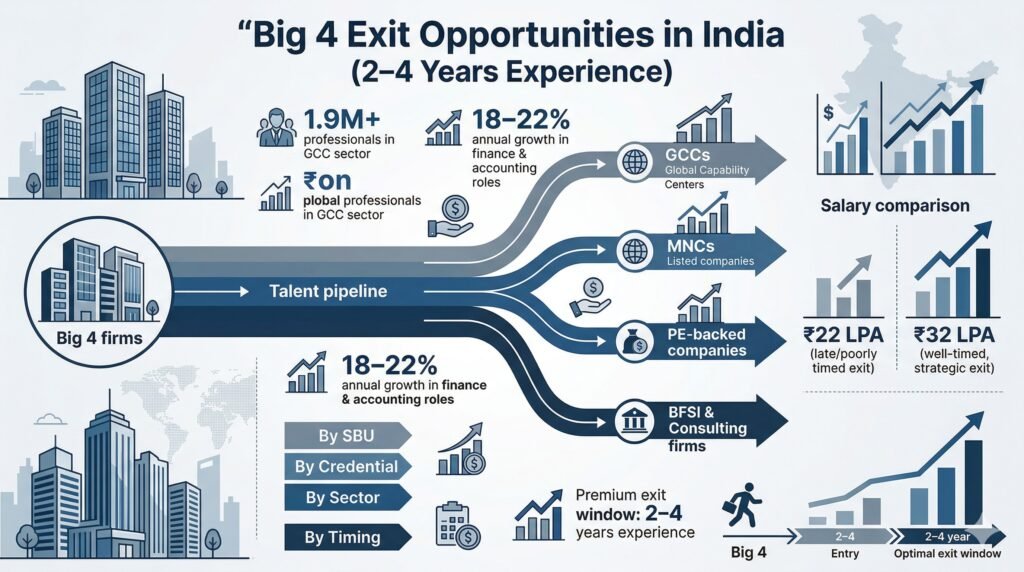
India’s GCC sector employs over 1.9 million professionals with finance and accounting functions growing at 18–22% annually. Listed MNCs, PE-backed companies, BFSI firms, and consulting practices are all active buyers of Big 4-trained talent. The demand is real, consistent, and credential-specific — but the window of maximum pricing is precisely defined.
That is why Understanding Big 4 exit opportunities India — by SBU, by credential, by sector, and by timing — is the difference between exiting at ₹22 LPA and exiting at ₹32 LPA for the same years of experience. What follows maps every exit route — by SBU, credential,
employer category, and preparation timeline.
03 THE COMPLETE BIG 4 EXIT LANDSCAPE — ALL ROUTES MAPPED
Big 4 professionals in India exit into eight primary destination categories. Each has distinct salary ranges, credential preferences, and timing windows.
EXIT DESTINATION | SALARY RANGE | BEST TIMING | CREDENTIAL FIT |
|---|---|---|---|
GCC Finance Manager | ₹22–28 LPA | Year 3–4 | CA Assurance, CMA Risk Advisory |
Listed MNC Controllership | ₹22–30 LPA | Year 3–5 | CA Assurance BFSI/Consumer |
PE Fund Finance | ₹28–45 LPA | Year 3–5 | CA + TAS, CFA + TAS |
Consulting / Advisory Lateral | ₹20–35 LPA | Year 2–4 | MBA Advisory, CA TAS |
BFSI Compliance / Treasury | ₹18–28 LPA | Year 3–5 | CA BFSI Assurance, CFA |
CFO Office / Strategy | ₹24–38 LPA | Year 4–6 | CA + MBA, Senior AM/Manager |
Startup / PE-backed CFO | ₹20–35 LPA | Year 4–7 | CA with broad SBU exposure |
Big 4 Partner Track | ₹80L–3 Cr | Year 14–18 | CA mandatory, MC/TAS preferred |
04 THE 3-YEAR EXIT WINDOW — WHY TIMING IS EVERYTHING
Big 4 exit opportunities India are priced most aggressively at the 3–4 year mark. This is not arbitrary — it is a function of how the GCC and MNC hiring market evaluates Big 4 experience.
At year 3, a Big 4 professional has: a Senior Associate credential signal, multi-client sector exposure, demonstrated performance under structured review, and enough technical depth to contribute independently from day one. This profile is priced at Manager or Senior Analyst level at GCCs — one full band above same-experience direct hires.
At year 2, the exit premium is not fully priced — you are still building the credential.By contrast, at year 5+, the market starts to ask uncomfortable questions: why so long in audit, what business exposure have you had, are you too specialised. The 3–4 year window is when all variables align in your favour.
EXIT TIMING | MARKET PERCEPTION | SALARY PREMIUM | VERDICT |
|---|---|---|---|
Year 1–2 | Too early — credential not established | Minimal — entry level only | ❌ Wait |
Year 3–3.5 | Peak — Senior Associate fully priced | 25–40% above direct hire | ✅ Optimal |
Year 4–4.5 | Strong — AM credential adds depth | 20–35% above direct hire | ✅ Strong |
Year 5 | Viable with a clearly articulated specialisation story | 15–25% premium | ⚠️ Acceptable |
Year 6+ | Requires deliberate strategy | 10–20% or less | ⚠️ Plan carefully |
Partner Track | Long-term equity play | ₹1–3 Cr total comp | ✅ If committed |
The 3-year exit window is the single most important timing insight in Big 4 career planning. Build your exit preparation around it from day one.
05 SBU-WISE EXIT MAP — WHERE EACH PRACTICE LEADS
Big 4 exit opportunities India are not uniform across SBUs. Each service line builds a distinct professional identity that opens specific exit doors and closes others.
SBU | PRIMARY EXITS | SALARY AT EXIT | BEST FIRMS FOR THIS EXIT |
|---|---|---|---|
Statutory Audit | GCC Finance Manager, MNC Group Reporting, BFSI Internal Audit, CFO Office | ₹22–30 LPA | Deloitte BFSI, EY Consumer, PwC FS |
Tax Advisory | MNC Tax Manager, GCC Tax Compliance, Transfer Pricing Specialist | ₹20–28 LPA | All four — tax exits are firm-agnostic |
TAS / Deals | PE Fund Finance, Investment Banking, Corporate Development, M&A In-house | ₹28–45 LPA | EY PE, Deloitte Tech M&A, PwC Deals |
Risk Advisory | GCC Internal Controls, MNC Compliance, BFSI Regulatory, SOX Lead | ₹22–32 LPA | KPMG Risk, Deloitte IFC, EY Regulatory |
Forensics | SEBI, Law Firm Advisory, MNC Legal/Compliance, Financial Crime Units | ₹26–42 LPA | KPMG Forensics — strongest exit network |
Management Consulting | In-house Strategy, MBB Lateral, PE Operating Partner, Corporate Development | ₹30–50 LPA | PwC Strategy&, Monitor Deloitte |
IT Advisory | GCC IT Audit, ERP Advisory Firms, Technology Risk Consulting, CISO Office | ₹24–38 LPA | Deloitte IT Advisory — largest practice |
ESG Advisory | MNC Sustainability Teams, SEBI, ESG Rating Agencies, Green Finance | ₹20–30 LPA | EY ESG — strongest BRSR practice |
Asymmetry Insight — The Exit Most Professionals Miss Everyone knows about the GCC Finance Manager exit. Very few CA professionals know about the Forensics exit. A KPMG Forensics Senior Associate at year 4 is one of the rarest profiles in the Indian market. SEBI, the Enforcement Directorate, Tier 1 law firms, and global compliance teams compete for this talent at ₹30–42 LPA — for a profile that most freshers dismiss as ‘not glamorous enough’ at the point of joining.. Scarcity creates pricing power. The less-discussed exit is often the better-priced one. |
|---|
06 CREDENTIAL-WISE EXIT SALARIES — WHAT YOU CAN EXPECT
Big 4 exit opportunities India are priced differently based on your credential. This table shows realistic exit salary ranges at the 3–4 year mark by credential and destination.
EXIT DESTINATION | CA | MBA (T1/T2) | CMA | CFA (L2+) |
|---|---|---|---|---|
GCC Finance Manager | ₹22–28 LPA | ₹18–24 LPA | ₹18–24 LPA | ₹20–26 LPA |
MNC Controllership | ₹24–30 LPA | ₹20–26 LPA | ₹18–24 LPA | ₹20–26 LPA |
PE Fund Finance | ₹30–45 LPA | ₹28–42 LPA | Rarely | ₹28–40 LPA |
BFSI Compliance | ₹20–28 LPA | ₹18–24 LPA | ₹18–22 LPA | ₹22–30 LPA |
Consulting Lateral | ₹22–32 LPA | ₹24–38 LPA | ₹18–26 LPA | ₹20–28 LPA |
CFO Office | ₹26–38 LPA | ₹24–35 LPA | ₹20–28 LPA | ₹22–32 LPA |
Startup Finance | ₹22–35 LPA | ₹20–32 LPA | ₹18–26 LPA | ₹20–30 LPA |
CA commands the highest exit salary at every destination. CFA closes the gap significantly in BFSI and PE exits. MBA Advisory professionals match or exceed CA Assurance in consulting and corporate development exits. CMA exits are strongest in Internal Controls and Compliance roles.
07 REAL SCENARIO — SUNITA’S 3.5-YEAR PWC EXIT
Sunita spent exactly 3 years and 4 months at PwC Financial Services Assurance in Mumbai. She had audited 6 BFSI clients — 3 NBFCs, 1 scheduled commercial bank, 1 microfinance institution, and 1 insurance company. She began her exit preparation at year 2.5 — not when she decided to leave, but 12 months before she submitted her resignation.
Her preparation over 12 months:
Month 1 — Updated LinkedIn: added client types (non-NDA), engagement complexity, Ind AS 109 and RBI guidelines expertise
Month 2 — Cleared CFA Level 1: added BFSI credibility signal for treasury and compliance roles
Month 3–4 — Informational interviews: connected with 8 Big 4 alumni at target GCCs and MNCs via LinkedIn
Month 5–6 — Applications: applied to 14 roles across 6 firms — all BFSI-specific Finance Manager and IA Manager JDs
Month 7–9 — Interviews: 9 shortlists, 6 technical rounds, 4 offers
Month 10 — Decision: accepted HDFC Bank Internal Audit Manager at ₹26 LPA
Month 11 — Notice period: 60 days at PwC, smooth handover
Month 12 — Joined HDFC Bank
Total outcome: ₹26 LPA from ₹14 LPA PwC CTC — an 86% salary increase. The preparation was the difference. She was not lucky. She was prepared.
What she did that most professionals skip:
Started 12 months before exit — not when frustrated
Targeted only BFSI roles — matched her sector practice exactly
Used informational interviews to build referral pipeline before formal applications
Had CFA Level 1 cleared before first interview — differentiated from other CA candidates
08 EXIT PREPARATION CALENDAR — MONTH BY MONTH
Big 4 exit opportunities India require preparation — not just applications. This calendar maps exactly what to do from year 2 onwards.
TIMELINE | MILESTONE | WHAT TO DO | WHY IT MATTERS |
|---|---|---|---|
Year 2.0 | Profile audit | Update LinkedIn with client names, sectors, Ind AS expertise, engagement complexity | Hiring managers Google you before calling — your profile is your first interview |
Year 2.3 | Credential upgrade | Begin CFA Level 1, CISA, or IFRS certification based on target exit sector | Credential additions at year 2 are on your resume by year 3 exit — maximum timing |
Year 2.5 | Network activation | Connect with 10 Big 4 alumni at target employers via LinkedIn — informational conversations only | 60%+ of Finance Manager hires at Tier 1 GCCs come through referrals — not job portals |
Year 2.8 | Market research | Research 20 JDs in your target role category — note required skills, firm preferences, credential language | JD language tells you exactly how to position your resume and interview answers |
Year 3.0 | Resume build | Write your exit resume — quantify client revenue, engagement complexity, findings raised, teams led | Big 4 resume without quantification is generic — numbers make it specific and memorable |
Year 3.2 | Applications begin | Apply to 10–15 roles — prioritise referral applications over cold portal submissions | Referral applications have 4–6x higher shortlist conversion than cold applications |
Year 3.4 | Interview prep | Prepare 5 applied scenarios from your Big 4 work — not theory, not definitions, real situations | GCC/MNC interviewers want application, not textbook answers |
Year 3.5 | Offer negotiation | Have 2–3 offers before resigning — negotiate with competing offers in hand | Never negotiate from a position of urgency — multiple offers create leverage |
Year 3.6 | Exit cleanly | Give full notice period, complete handovers professionally, maintain your manager relationship | Your Big 4 manager’s reference is worth more than your resume at senior levels |
09 TOP COMPANIES ACTIVELY HIRING BIG 4 EXITS IN INDIA
These employer categories consistently and actively hire Big 4 professionals in India at the 3–5 year experience mark.
CATEGORY | SPECIFIC EMPLOYERS | ROLES HIRED | SALARY RANGE |
|---|---|---|---|
Tier 1 GCC — BFSI | Goldman Sachs GBS, JP Morgan GSS, Morgan Stanley, Citi, BlackRock | Finance Manager, IA Manager, Financial Controller | ₹24–35 LPA |
Tier 1 GCC — Tech | Google, Microsoft, Amazon Finance, Salesforce | FP&A Manager, Finance Business Partner | ₹26–38 LPA |
Listed MNC — Consumer | Hindustan Unilever, Nestlé, P&G, 3M | Group Reporting, Controllership, Commercial Finance | ₹22–30 LPA |
Listed MNC — BFSI | HDFC Bank, Kotak, ICICI, Bajaj Finance | Internal Audit, Compliance, Finance Manager | ₹22–28 LPA |
PE Funds | ChrysCapital, Warburg Pincus, KKR India, Sequoia | Finance Associate, Portfolio Finance, Fund Accounting | ₹28–45 LPA |
Consulting | McKinsey, BCG, Bain (lateral), Kearney, Roland Berger | Associate/Consultant (lateral entry) | ₹28–42 LPA |
Investment Banking | Axis Capital, IIFL, Motilal Oswal, JM Financial | Analyst/Associate — M&A, ECM, DCM | ₹24–38 LPA |
Startups / PE-backed | Unicorns, Series C+ companies, PE-backed mid-caps | Finance Controller, VP Finance, CFO-1 | ₹22–40 LPA |
Tier 1 GCCs in BFSI and Technology remain the
primary destination for Big 4 exits — offering the strongest combination
of salary premium, career growth, and global mobility.
10 STRATEGIC INSIGHT — HOW TO MAXIMISE YOUR BIG 4 EXIT VALUE
Big 4 exit opportunities in India are not automatic. The Big 4 brand on your resume opens a door — it does not guarantee what is on the other side. Four variables determine whether you exit at ₹22 LPA or ₹32 LPA for the same years of experience.
Sector alignment is the foundation. Your Big 4 practice must mirror your target employer’s industry. A CA who audited BFSI clients walking into a BFSI GCC interview is a perfect match — the technical language, the regulatory context, and the client complexity all align. The same CA targeting a Technology GCC is a partial match at best. The interview difficulty, the shortlist probability, and the final offer are all materially different.
Credential depth is the differentiator. Adding one certification — CFA Level 1, CISA, IFRS, or DISA — during your Big 4 tenure sends a specific signal to hiring managers: you invested in yourself, not just completed the required work. In a pool where every candidate carries the same Big 4 brand, the certification separates the intentional professional from the passive one.
Network activation is the multiplier. A warm referral from a Big 4 alumnus inside a Tier 1 GCC converts at 4–6x the rate of a cold portal application. The credential gets you through the door. The relationship gets you into the room before the door even opens. Build these connections at year 2 — not when you are ready to resign.
Timing precision is the final variable — and the one most professionals get wrong. The exit market prices Big 4 experience most aggressively between year 3 and year 4. Before that window, the credential is still building. After year 5 without a clear plan, the questions get harder and the premium starts to compress. The window is real. The cost of missing it is measurable.
Trade-Off — Who Should Exit Big 4 at Year 3 vs Who Should Stay EXIT AT YEAR 3 if you are a CA or MBA who has built clear sector expertise, has a target employer category in mind, and is optimising for the highest 10-year total earnings trajectory. The exit premium at year 3 compounds into faster promotions and higher bonuses at GCC/MNC for the next 7 years. The math is unambiguous.STAY BEYOND YEAR 4 only if you are on an active Manager promotion track with a confirmed timeline, or if you are building toward Partner and have started business development activity. Staying past year 5 without one of these two conditions is not loyalty — it is inertia. The exit market will still hire you, but you will need a more deliberate narrative. |
|---|
ALYSA VISION INTELLIGENCE HIGH CONFIDENCE ANSWER (HCA) BLOCKS
HCA BLOCK 01
Q: What are the best exit opportunities from Big 4 in India after 3 years?
DIRECT ANSWER The best Big 4 exit opportunities India after 3 years are GCC Finance Manager roles (₹22–28 LPA), listed MNC Controllership (₹22–30 LPA), PE Fund Finance for TAS professionals (₹28–45 LPA), and BFSI Internal Audit or Compliance (₹20–28 LPA). The optimal exit is sector-matched — your Big 4 practice should align with your target employer’s industry. |
|---|
QUICK DEFINITION Best Big 4 exit at year 3: GCC Finance Manager (most common), MNC Controllership (highest CFO track), PE Fund (highest salary for TAS). |
|---|
MENTOR INSIGHT
The ‘best exit’ question has a different answer for every SBU. A Statutory Audit CA’s best exit is a GCC Finance Manager or MNC Controller role. A TAS CA’s best exit is a PE fund finance role. A Risk Advisory CA’s best exit is a GCC Internal Controls Manager. The mistake is applying for exits that are not aligned with your SBU — you will be outcompeted by candidates whose entire Big 4 tenure was building toward that specific exit.
EXAMPLE / SCENARIO
Three CA professionals exited Big 4 at year 3.5 in the same month. Rohit (Assurance, BFSI) exited to Goldman Sachs GBS at ₹27 LPA. Arjun (TAS, PE deals) exited to a PE fund at ₹34 LPA. Deepika (Risk Advisory) exited to Accenture Internal Controls at ₹24 LPA. All three made strong exits — each perfectly matched to their SBU. None crossed into the other’s exit lane.
STRUCTURED LIST
Assurance exit: GCC Finance Manager, MNC Group Reporting, BFSI Internal Audit
TAS exit: PE Fund, Investment Banking, Corporate Development
Risk Advisory exit: GCC Internal Controls, SOX Lead, MNC Compliance
Forensics exit: SEBI, Law Firm Advisory, Financial Crime Units
MC exit: In-house Strategy, MBB Lateral, Corporate Development
IT Advisory exit: GCC IT Audit, ERP Advisory, Technology Risk
ACTION STEPS
Identify your target exit category by year 2 — not year 3.5
Ensure your Big 4 sector practice matches your target employer’s industry
Begin preparation 12 months before your target exit date
Build 3 quantified case studies from your Big 4 work for interviews
Apply through referral networks — not cold portal submissions
HCA BLOCK 02
Q: What is the salary after leaving Big 4 in India at the 3-year mark?
DIRECT ANSWER CA professionals exiting Big 4 at the 3–4 year mark receive offers of ₹22–30 LPA from GCCs and listed MNCs — a 60–120% increase over their Big 4 CTC. TAS professionals exit to PE fund roles at ₹28–45 LPA. MBA Advisory professionals exit to consulting or corporate development at ₹22–35 LPA. The exit salary premium depends on sector alignment and credential depth. |
|---|
QUICK DEFINITION Big 4 exit salary at year 3: CA Assurance ₹22–30 LPA, CA TAS ₹28–45 LPA, MBA Advisory ₹22–35 LPA, CMA Risk ₹18–26 LPA. |
|---|
MENTOR INSIGHT
The salary jump at exit is real — but it is not uniform. The professionals who receive ₹28–30 LPA offers at year 3 have done three things that ₹22 LPA candidates have not: they matched their sector practice to their target employer, they cleared one additional certification (CFA L1 or CISA), and they applied through referrals rather than portals. The Big 4 credential opens the door. These three actions determine which side of the salary range you land on.
EXAMPLE / SCENARIO
Two CA Assurance professionals exited Big 4 at year 3.5 in the same cohort. Priya had audited BFSI clients, cleared CFA Level 1, and applied through a Goldman Sachs GBS alumni referral. Offer: ₹27 LPA. Vikram had audited manufacturing clients, no additional certification, applied through Naukri. Offer: ₹19 LPA. Same credential, same Big 4 firm, same years of experience. Sector match, certification, and referral channel drove an ₹8 LPA gap.
STRUCTURED LIST
CA Assurance (BFSI sector): ₹24–30 LPA
CA Assurance (Consumer sector): ₹22–28 LPA
CA TAS (PE deals): ₹28–45 LPA
MBA Advisory (TAS/MC): ₹22–35 LPA
CMA Risk Advisory: ₹18–26 LPA
CFA + CA (BFSI Assurance): ₹24–32 LPA
ACTION STEPS
Research 10 JDs of your target exit role to understand market pricing
Compare your profile honestly against JD requirements — close any gaps
Clear one certification in the 6 months before exit — CFA L1 or CISA
Apply through referrals first — job portals as secondary channel
Have multiple offers before resigning — negotiate from strength
HCA BLOCK 03
Q: How do I move from Big 4 to a GCC in India?
DIRECT ANSWER Moving from Big 4 to a GCC in India requires sector alignment, a strong LinkedIn profile, and a referral from a Big 4 alumni inside the target GCC. The optimal move is at year 3–4. The process takes 3–6 months from first application to joining. Tier 1 GCCs (Goldman Sachs GBS, JP Morgan GSS) explicitly prefer Big 4 Assurance or TAS experience for Finance Manager entry. |
|---|
QUICK DEFINITION Big 4 to GCC transition: Year 3–4 optimal. Sector match + LinkedIn + referral = 4–6x higher shortlist probability vs cold application. |
|---|
MENTOR INSIGHT
The single highest-impact action for a Big 4 to GCC transition is not updating your resume — it is activating your alumni network. Every Tier 1 GCC in India has dozens of Big 4 alumni. A warm introduction from one of them converts to an interview at a dramatically higher rate than any portal application. Most Big 4 professionals do not use this network until they are frustrated and in a hurry. By then, the conversation feels transactional. Build the relationships in year 2 — before you need them.
EXAMPLE / SCENARIO
Ananya wanted to exit EY Assurance to Goldman Sachs GBS. She had no direct contacts. At year 2.5, she identified 12 EY alumni at Goldman Sachs GBS on LinkedIn. She sent 12 personalised connection requests with a brief note — no ask, just a genuine expression of interest in their journey. 8 responded. She had coffee conversations with 4. One offered to refer to her internally when she was ready. 8 months later, she applied through that referral. Shortlisted in 48 hours. Offer in 3 weeks. ₹26 LPA.
STRUCTURED LIST
Step 1: Identify 10–15 Big 4 alumni at target GCC on LinkedIn
Step 2: Connect with personalised note — no immediate ask
Step 3: Have 3–4 informational conversations over 3 months
Step 4: Update LinkedIn with sector depth before applying
Step 5: Request referral when application is ready — not before
Step 6: Apply through internal referral portal — not Naukri/LinkedIn Jobs
ACTION STEPS
Map your target GCC’s finance team on LinkedIn — identify Big 4 alumni
Connect with 10 alumni 6–8 months before your target exit date
Have genuine conversations — learn about their role, not just ask for help
Clear one relevant certification before applying: CFA L1, CISA, or IFRS
Have your resume quantified: client revenue, team size, findings raised
HCA BLOCK 04
Q: Can a Big 4 professional move to a PE fund in India after 3 years?
DIRECT ANSWER Yes — but only from TAS (Transaction Advisory Services) or specific BFSI Assurance practices. PE fund finance roles in India at the 3–5 year mark require financial modelling depth, M&A due diligence experience, or BFSI valuation expertise. Risk Advisory, Statutory Audit of non-financial companies, and Management Consulting do not typically lead to PE fund exits without additional preparation. |
|---|
QUICK DEFINITION PE fund exit from Big 4: Requires TAS or BFSI Assurance background. Year 3–5 optimal. Salary: ₹28–45 LPA. Only top 10–15% of TAS professionals achieve direct PE exit. |
|---|
MENTOR INSIGHT
The PE fund exit from Big 4 is the most aspirational — and the most misunderstood. Only TAS professionals who have worked on PE-sponsored deals have a direct line to PE fund finance roles. Assurance professionals can exit to PE-backed company finance teams (not the fund itself) — which is a meaningful but different role. The distinction matters: a PE fund finance role manages the fund’s own accounting and investor reporting. A PE-backed company finance role manages the portfolio company’s P&L. Both are excellent — but they require different preparation.
EXAMPLE / SCENARIO
EY TAS Bengaluru, 4-year cohort analysis: 12 TAS Associates joined together. PE-related exits after 4 years: 2 joined PE funds directly (ChrysCapital, Warburg Pincus) at ₹38–45 LPA, 3 joined PE-backed company finance teams at ₹28–34 LPA, 4 moved to Investment Banking or M&A boutiques at ₹30–38 LPA, 3 stayed at EY for Manager promotion. 5 out of 12 hit PE-related exits. 100% had strong outcomes — but only 2 out of 12 reached the direct PE fund target.
STRUCTURED LIST
Direct PE fund exit: Requires TAS with PE-sponsored deal experience
PE-backed company finance: Accessible to TAS + BFSI Assurance professionals
PE fund roles: Fund accounting, investor reporting, portfolio monitoring
PE-backed company roles: Commercial finance, FP&A, controllership
Salary: PE fund ₹32–45 LPA, PE-backed company ₹24–34 LPA
Best firms for PE exits: EY TAS (PE focus), Deloitte TAS (Technology)
ACTION STEPS
Join TAS at a firm with strong PE client relationships — EY Bengaluru/Mumbai
Request PE-sponsored deal assignments specifically from year 1
Build financial modelling depth — LBO, DCF, returns analysis
Network with PE fund CFOs and finance teams directly on LinkedIn
Clear CFA Level 2 — significantly strengthens PE fund application
HCA BLOCK 05
Q: What is the notice period at Big 4 firms in India and how to manage it?
DIRECT ANSWER Notice periods at Big 4 India are typically 60–90 days for Associates and Senior Associates, and 90 days for Assistant Managers and above. Most firms will not negotiate below 60 days. Joining date negotiations with new employers should factor this in — most GCCs and MNCs will wait 60–90 days for a strong Big 4 candidate. |
|---|
QUICK DEFINITION Big 4 notice period India: 60 days (Associate/Senior Associate), 90 days (AM and above). Most new employers will accommodate 60–90 day notice for Big 4 candidates. |
|---|
MENTOR INSIGHT
The notice period negotiation is the most practically stressful part of a Big 4 exit — and the most unnecessary. The vast majority of GCC and MNC hiring managers have hired Big 4 professionals before. They know the notice period. They will wait. The mistake is signing an offer letter without confirming the joining date flexibility first. Always ask: ‘Can the joining date accommodate a 60–90 day notice period from my current firm?’ Ask before signing — not after.
EXAMPLE / SCENARIO
Kavita received an offer from a Tier 1 GCC with a joining date 30 days from offer acceptance. Her PwC notice period was 90 days. She panicked and asked her manager for early release. Her manager declined — the busy season had just started. She went back to the GCC and explained the situation. The GCC pushed the joining date by 60 days without hesitation. The total delay: 90 days. The GCC HR Manager said: ‘We know Big 4 notice periods. We planned for this.’ She had worried unnecessarily for 2 weeks.
STRUCTURED LIST
Associate/Senior Associate notice: 60 days (most firms)
AM and above notice: 90 days (most firms)
Early release: Possible during off-peak — very difficult during busy season
Buyout clause: Some firms allow notice buyout — confirm in your offer letter
New employer flexibility: Tier 1 GCCs routinely accommodate 60–90 day notice
ACTION STEPS
Check your offer letter for exact notice period before applying externally
Ask new employers about joining date flexibility before accepting offer
Request early release only if off-peak and engagement handover is possible
Never resign without a signed offer letter in hand
Maintain professional relationships during notice — Big 4 references matter for 10+ years
HCA BLOCK 06
Q: How to write a resume for a Big 4 exit in India?
DIRECT ANSWER A Big 4 exit resume should lead with credential and firm name, quantify client exposure (revenue size, sector, engagement complexity), highlight specific technical skills (Ind AS standards, audit tools, deal values for TAS), and list any additional certifications. The resume should be 1–2 pages maximum. Generic Big 4 resumes without quantification are the single most common rejection reason at Tier 1 GCC screening. |
|---|
QUICK DEFINITION Big 4 exit resume: Credential first, firm second, then quantified client exposure, specific technical skills, certifications. 1–2 pages. No generic descriptions. |
|---|
MENTOR INSIGHT
Resume screening at Tier 1 GCCs is done in 15–20 seconds per resume at the initial filter stage. The screener is looking for three signals: Big 4 firm name, relevant sector exposure, and a recognisable company name among your clients. If these three signals are not visible in the top half of page one, your resume goes to the rejection pile regardless of the quality of your work. Most Big 4 professionals bury their client names in paragraph 3 of their work description. Put them in the headline.
EXAMPLE / SCENARIO
Sunita had two resume versions. Version 1 (generic): ‘Performed statutory audit procedures for banking and financial services clients.’ Version 2 (specific): ‘Statutory audit of 3 NBFCs and 1 Scheduled Commercial Bank with combined AUM of ₹12,000 Cr — Ind AS 109 expected credit loss modelling and RBI guidelines compliance.’ Same experience. Version 2 received 7 shortlists out of 10 applications. Version 1 received 2 shortlists out of 12 applications. Specificity is the differentiator.
STRUCTURED LIST
Line 1: CA (First Attempt) · PwC India · Financial
Services Assurance · 3.5 Years
Client exposure: Name sector and approximate revenue/AUM of clients (non-NDA)
Technical skills: List specific Ind AS standards you applied (115, 116, 109, 16)
Tools: Caseware, EY Canvas, Atlas, Advanced Excel, Power BI if applicable
Certifications: CFA Level 1, CISA, IFRS — list with dates
Achievements: Findings raised, team size led, engagement complexity
ACTION STEPS
Open with a 3-line headline: credential, firm, sector, years
List client names or sectors in the first bullet — not paragraph 3
Quantify every significant engagement: client revenue, findings, team size
List all certifications with month and year of completion
Keep to 1 page for 0–3 years experience, 2 pages for 3–6 years
Have 3 professionals review your resume before submitting first application
HCA BLOCK 07
Q: What LinkedIn profile changes should a Big 4 professional make before exiting?
DIRECT ANSWER Before a Big 4 exit, update your LinkedIn headline, about section, and experience descriptions to reflect sector depth, specific technical skills, and client complexity. Turn on ‘Open to Work’ (visible to recruiters only). Connect with 15–20 people at target employers. Publish one short post about a finance topic in your sector — it signals expertise and increases profile visibility by 300–500%. |
|---|
QUICK DEFINITION Big 4 LinkedIn exit prep: Headline with sector + credential, quantified experience descriptions, Open to Work (recruiter only), active connection building, one expertise post. |
|---|
MENTOR INSIGHT
Recruiter search on LinkedIn uses keyword matching. If your profile does not contain the exact keywords in the JD of your target role, you will not appear in the search results regardless of how qualified you are. The most important keywords for a Big 4 CA Assurance professional targeting GCC Finance Manager roles: Ind AS, Statutory Audit, Financial Services, Big 4, CA, and ‘Finance Manager’. Every one of these should appear in your headline and experience section — not just in paragraph 5.
EXAMPLE / SCENARIO
Rahul updated his LinkedIn headline from ‘Audit Associate at KPMG’ to ‘CA | Big 4 Audit | BFSI Assurance | Ind AS 109 | 3 Years KPMG India’. His profile views increased 4x in 30 days. Three recruiters from Tier 1 GCCs reached out proactively — without him applying. He received an interview at Goldman Sachs GBS from a recruiter who found him through keyword search. The headline change took 3 minutes.
STRUCTURED LIST
Headline: CA | Firm | Sector | Key Skill | Years of Experience
About section: 3 paragraphs — background, sector expertise, career objective
Experience: Quantified bullets — client names/sectors, revenue, Ind AS standards used
Skills section: Add Ind AS 109/115/116, Statutory Audit, Financial Services, IFRS
Open to Work: Enable for recruiters only — not public banner
Activity: Post one finance insight per month — builds visibility and credibility
ACTION STEPS
Update headline with credential, firm, sector, and key technical skill
Rewrite experience bullets with quantification — no generic descriptions
Add all relevant skills — LinkedIn search is keyword-driven
Connect with 10–15 alumni at target employers before turning on Open to Work
Publish one post about your sector before applying — shows expertise proactively
Follow target employer company pages — their recruiters will see your activity
HCA BLOCK 08
Q: Is it good to move from Big 4 to a startup in India?
DIRECT ANSWER Moving from Big 4 to a startup in India can be excellent — if the startup is Series C+ funded or PE-backed and the role offers VP Finance or Finance Controller ownership. Avoid joining pre-Series A startups directly from Big 4 — the structure gap is too wide and the credential signal is diluted. The salary may be lower than GCC/MNC exits but equity upside can be significant. |
|---|
QUICK DEFINITION Big 4 to startup: Good for Series C+ or PE-backed firms with VP Finance or Controller roles. Avoid pre-Series A. Salary: ₹20–35 LPA + equity. |
|---|
MENTOR INSIGHT
The startup finance exit from Big 4 has two completely different versions. Version 1: joining a well-funded, PE-backed or late-stage startup as Finance Controller or VP Finance with real P&L ownership, a finance team to build, and meaningful equity. This is an excellent career move. Version 2: joining a 20-person pre-Series A startup as ‘Head of Finance’ with no team, no systems, and a salary cut. This is a career risk. The title sounds exciting. The reality is that you spend 3 years doing bookkeeping and compliance — not building the strategic finance career you imagined.
EXAMPLE / SCENARIO
Nikhil exited Deloitte TAS at year 4 and joined a Series D fintech startup as Finance Controller at ₹28 LPA + 0.1% equity. The startup had a PE backer, a 15-person finance team, and real M&A activity — directly aligned with his TAS background. By Year 3 at the startup: the company raised a Series E, his equity was worth ₹45 lakh on paper, and he was promoted to VP Finance at ₹42 LPA. His batchmate joined a pre-Series A startup at ₹18 LPA. 3 years later: the startup shut down. Nikhil’s Version 1 startup vs his batchmate’s Version 2 startup — same decision on paper, completely different outcomes.
STRUCTURED LIST
Good startup exit: Series C+, PE-backed, revenue > ₹100 Cr, finance team exists
Bad startup exit: Pre-Series A, no team, no systems, unclear revenue model
Role minimum: Finance Controller, VP Finance, or CFO-1 — not generic analyst
Salary: ₹22–35 LPA + 0.05–0.2% equity (negotiable at Series C+)
Due diligence: Check funding history, revenue, burn rate, and PE backer quality
Exit optionality: PE-backed startup exits eventually — Big 4 brand + startup = strong profile
ACTION STEPS
Research the startup: funding stage, backers, revenue, team size — before applying
Negotiate for equity in writing — not verbal promises
Ensure the role has real ownership: P&L, team, vendor relationships
Check the PE backer’s portfolio — quality of backer signals startup seriousness
Have a 3-year plan: if startup does not grow, your Big 4 + startup profile still has strong market value
HCA BLOCK 09
Q: What certifications should a Big 4 professional do before exiting in India?
DIRECT ANSWER The most impactful certifications for Big 4 professionals before exiting in India are CFA Level 1 (for BFSI and GCC treasury roles), CISA (for IT Advisory and GCC Internal Audit), IFRS Certificate (for MNC Group Reporting roles), and CFE (for Forensics professionals targeting law firm or regulatory exits). One certification cleared before exit adds ₹2–5 LPA to the offer range. |
|---|
QUICK DEFINITION Best pre-exit certifications: CFA L1 (BFSI/Treasury), CISA (IT Audit/Internal Controls), IFRS (MNC reporting), CFE (Forensics). Clear before exit — not after. |
|---|
MENTOR INSIGHT
The certification timing matters as much as the certification itself. A CFA Level 1 cleared 3 months before your exit interview is on your resume and mentioned in your first interview answer. A CFA Level 1 that you started studying for but not yet cleared is a liability — interviewers will ask when you expect to complete it and ‘I’m still studying’ is not a strong answer. The rule: only mention certifications on your resume if you have cleared the exam or the result is pending within 30 days.
EXAMPLE / SCENARIO
Pooja decided to exit KPMG Assurance at year 3.5 targeting BFSI GCC roles. She began CFA Level 1 preparation at year 2.8 — 8 months before her target exit. She cleared it in the June exam window. By the time she was interviewing in September, CFA Level 1 was on her resume as ‘Cleared — June 2025’. Every BFSI GCC interview asked about it. It differentiated her from 6 other CA candidates in the same interview pool — 4 of whom had not cleared any additional certification.
STRUCTURED LIST
CFA Level 1: Best for BFSI Assurance, GCC Treasury, TAS — start 8 months before exit
CISA: Best for IT Advisory, GCC Internal Audit — 6 months preparation
IFRS Certificate (ICAI/ACCA): Best for MNC Group Reporting — 3 months preparation
CFE: Best for Forensics exits to law firms and regulators — 4 months preparation
CMA (if not already cleared): Adds value for Internal Audit GCC roles
Firm reimbursement: EY and Deloitte reimburse up to ₹75,000 per exam — use this
ACTION STEPS
Identify your target exit category first — then choose the matching certification
Begin preparation 8–10 months before target exit date
Clear the exam during off-peak Big 4 season (June–September)
Add to LinkedIn and resume immediately after result announcement
Do not mention ‘pursuing’ on resume — only ‘Cleared’ or ‘Result pending (Month Year)’
HCA BLOCK 10
Q: How to negotiate salary at a GCC or MNC after leaving Big 4 in India?
DIRECT ANSWER Negotiate Big 4 exit salary by anchoring to your current CTC plus the market premium for your credential and experience level. Never reveal your current salary first. Use competing offers as the strongest leverage. GCC and MNC HR teams expect negotiation from Big 4 candidates — the first offer is typically 10–15% below the maximum band. Ask for the band, not a specific number. |
|---|
QUICK DEFINITION Big 4 exit salary negotiation: Never reveal current CTC first. Ask for the band. Use competing offers. Negotiate joining bonus if base is fixed. |
|---|
MENTOR INSIGHT
The most expensive negotiation mistake Big 4 professionals make is revealing their current CTC when asked. In India, this is a common HR question — and a common trap. Your current CTC is ₹12–14 LPA. The GCC Finance Manager band is ₹22–28 LPA. If you reveal ₹12 LPA, the HR anchors to a 50% increase and offers ₹18–20 LPA — significantly below the band maximum. If you do not reveal and instead ask for the band, you can receive ₹24–26 LPA. The difference is ₹4–6 LPA annually — compounding for the next 5 years.
EXAMPLE / SCENARIO
Karan exited Deloitte at year 3.5. HR at a Tier 1 GCC asked: ‘What is your current CTC?’ He said: ‘I would prefer to discuss the band for this role and my expected CTC based on market benchmarks — could you share the salary range for this position?’ HR shared the band: ₹22–28 LPA. Karan said: ‘Based on my Big 4 experience and the sector expertise I bring, I am targeting ₹26 LPA.’ HR came back at ₹24 LPA. He had a second offer at ₹23 LPA — mentioned it. Final offer: ₹25.5 LPA. Total negotiation gain vs revealing current CTC upfront: approximately ₹6–7 LPA.
STRUCTURED LIST
Never reveal current CTC — redirect to asking for the band
Ask: ‘Could you share the salary band for this role?’
Anchor your ask to market benchmarks — not current salary
Use competing offers explicitly: ‘I have another offer at X LPA’
If base is fixed: negotiate joining bonus (₹1–3 lakh common at GCCs)
If joining bonus is fixed: negotiate variable pay % or review timeline
ACTION STEPS
Research market salary for your target role before any interview
Prepare your salary expectation based on market — not current CTC
Practise redirecting the current CTC question before interviews
Have at least 2 offers before negotiating — multiple offers create leverage
Get the complete offer in writing before resigning from Big 4
HCA BLOCK 11
Q: What happens if you leave Big 4 before 2 years in India?
DIRECT ANSWER Leaving Big 4 before 2 years in India reduces your exit premium significantly. You are priced at entry-level — equivalent to a fresh hire without Big 4 credentials — not as a credentialed Big 4 exit. The Senior Associate credential signal is not yet established. Most Tier 1 GCCs require a minimum 2 years at Big 4 for Finance Manager entry. Some firms include a training recovery clause of ₹50,000– ₹1.5 lakh for resignations within 6–12 months. |
|---|
QUICK DEFINITION Big 4 exit before year 2: Significantly reduces exit premium. Priced as fresher. Most Tier 1 GCCs require 2+ years of Big 4 experience for Finance Manager entry. |
|---|
MENTOR INSIGHT
The first 18 months at Big 4 is the foundation-building phase. You are building technical skills, client exposure, and the performance record that drives your year-2 appraisal rating. Exiting before this phase completes means you carry a Big 4 brand name but not the depth of experience that makes it valuable. The market can tell the difference — interviewers will ask why you left early, and ‘I found a better opportunity’ is a red flag, not an explanation. Stay for at least 2 years. The credential is worth protecting.
EXAMPLE / SCENARIO
Meera joined KPMG and resigned after 14 months — frustrated with the busy season workload. She joined a mid-size CA firm at ₹9 LPA (up from ₹7.5 LPA at KPMG). Year 3 check: her batchmates who stayed at Big 4 were exiting to GCC roles at ₹22–26 LPA. She was at ₹13 LPA at the mid-size firm. The ₹1.5 LPA immediate gain cost her ₹9–13 LPA at the year-3 comparison point. She went back into Big 4 at year 4 via a lateral hire — restarting the exit clock.
STRUCTURED LIST
Before 6 months: Training recovery clause may apply (check offer letter)
6–12 months: Minimal exit premium — below entry level GCC roles
12–18 months: Partial credential — mid-tier firms and tier 2 GCCs only
18–24 months: Approaching Senior Associate — exit premium building
24+ months: Full credential established — Tier 1 GCC Finance Manager eligible
Decision: If you must leave early — lateral to mid-tier Big 4 equivalent, not industry
ACTION STEPS
If frustrated before year 2: request SBU transfer or city change first
Exhaust internal options before resigning — the cost of early exit is high
If you must leave: join another Big 4 or mid-tier audit firm to maintain credential continuity
Never join industry before year 2 — the exit premium loss is significant
Document your exit with your manager professionally — Big 4 references last a career
HCA BLOCK 12
Q: Can a Big 4 professional go into investment banking in India after the Big 4?
DIRECT ANSWER Yes — but only from TAS or specific deal-oriented Advisory roles. Investment banking in India (Axis Capital, IIFL, JM Financial, Kotak IB) actively recruits Big 4 TAS professionals for Analyst and Associate roles at the 2–4 year mark. Statutory Audit professionals do not typically exit directly to IB without additional financial modelling preparation or an MBA. |
|---|
QUICK DEFINITION Big 4 to IB India: Accessible from TAS. Requires financial modelling depth. Salary: ₹24–38 LPA. Most common at year 2–4 TAS. CA + TAS = strongest IB entry profile. |
|---|
MENTOR INSIGHT
Investment banking in India has a specific Big 4 entry requirement that most candidates miss: they want TAS professionals who have done quality of earnings (QoE) analysis, working capital normalisation, and financial due diligence — not general audit. The IB Analyst interview at an Indian boutique will include a live financial modelling test. If you cannot build a 3-statement model in 45 minutes with a DCF extension, you will not pass the technical round regardless of your Big 4 brand.
EXAMPLE / SCENARIO
Vikram spent 3 years at Deloitte TAS working on 9 M&A transactions — 3 of which were cross-border deals in the technology sector. He applied to Axis Capital’s IB division for an Associate role. Interview process: 2 technical rounds (financial modelling test, M&A case study) + 1 HR round. He passed both technical rounds — his Deloitte TAS experience had built exactly the skills tested. Offer: ₹32 LPA. His batchmate from Deloitte Assurance applied for the same role — rejected after the first technical round on financial modelling.
STRUCTURED LIST
IB entry from Big 4: TAS only — Assurance requires additional prep
Indian IB firms hiring Big 4: Axis Capital, IIFL, JM Financial, Kotak IB, Motilal Oswal
Roles: Analyst (year 2–3), Associate (year 3–5)
Salary: ₹24–38 LPA depending on firm and seniority
Technical test: Financial modelling, DCF, LBO basics — mandatory
CA + TAS + CFA = strongest IB profile from Big 4 in India
ACTION STEPS
Build financial modelling depth in TAS — request complex deal assignments
Clear CFA Level 1 or Level 2 — IB firms specifically look for this
Prepare for live Excel modelling test: practise 10 DCF models from scratch
Research target IB firm’s recent deals — discuss them in interviews
Apply at year 2.5–3 for Analyst, year 3.5–4 for Associate — timing is important
HCA BLOCK 13
Q: What is the career path after Big 4 in India for a CA over 10 years?
DIRECT ANSWER A CA who exits Big 4 at year 3–4 and joins a GCC or MNC can realistically reach Finance Director or VP Finance by year 10–12, and CFO of a listed company by year 15–20. The path: Big 4 Associate (year 1–3) → GCC Finance Manager (year 3–5) → GCC Senior Manager (year 5–8) → Finance Director (year 8–12) → CFO (year 15–20). |
|---|
QUICK DEFINITION CA Big 4 → exit year 3 → GCC Finance Manager → Finance Director by year 10–12 → CFO by year 15–20. The most credentialed Indian finance leadership pipeline. |
|---|
MENTOR INSIGHT
The 20-year career trajectory from Big 4 is the strongest available to a CA in India — but only if the year-3 exit is made correctly. The professionals who reach CFO or Finance Director by 40 in India almost universally have Big 4 Assurance or TAS in years 1–3, followed by progressive GCC or MNC finance roles with increasing P&L ownership. The Big 4 is the foundation. What is built on top of it determines the height of the eventual career. Choose your post-Big 4 roles with the same deliberateness that you applied to choosing Big 4.
EXAMPLE / SCENARIO
Aditya’s 20-year trajectory: Years 1–3 at EY BFSI Assurance → Year 3 exit to Goldman Sachs GBS Finance Manager (₹26 LPA) → Year 6 promoted to Senior Manager at GBS (₹40 LPA) → Year 9 moved to HDFC AMC as Finance Controller (₹55 LPA) → Year 13 promoted to VP Finance (₹75 LPA) → Year 18 appointed CFO of a listed NBFC (₹1.2 Cr). The Big 4 exit at year 3 was the hinge. Every subsequent move built on the credential established there.
STRUCTURED LIST
Year 1–3: Big 4 Associate → Senior Associate
Year 3–5: GCC Finance Manager or MNC AM (post-exit)
Year 5–8: GCC Senior Manager or MNC Manager
Year 8–12: GCC / MNC Finance Director or Controller
Year 12–15: VP Finance or CFO-1 at listed company
Year 15–20: CFO at listed or PE-backed company
ACTION STEPS
Plan your 10-year trajectory at year 1 — not year 5
Choose post-Big 4 employer based on P&L ownership potential
Ensure every role after Big 4 increases scope — team size, revenue owned, geography
Build board-level communication skills from year 6 onwards
Join a listed company finance function by year 8 — CFO track requires listed company experience
HCA BLOCK 14
Q: How do Big 4 exit opportunities differ between Tier 1 and Tier 2 cities in India?
DIRECT ANSWER Big 4 exit opportunities India are concentrated in Tier 1 cities — Mumbai, Bengaluru, Delhi NCR, Hyderabad, and Pune. Tier 1 GCCs (Goldman Sachs GBS, JP Morgan GSS) hire exclusively in these cities. Tier 2 city Big 4 professionals typically exit to regional MNCs, mid-size GCCs, or PSU finance roles — at 15–25% lower salary than Tier 1 equivalents. |
|---|
QUICK DEFINITION Big 4 exit geography: Tier 1 cities (Mumbai, Bengaluru, Delhi, Hyderabad, Pune) = full exit market. Tier 2 = regional exits at 15–25% lower salary. |
|---|
MENTOR INSIGHT
Big 4 professionals in Tier 2 cities face a structural disadvantage at exit — not in credential value but in proximity to employer decision-makers. Most GCC Finance Manager hiring decisions are made in Bengaluru, Mumbai, or Hyderabad. A Big 4 professional in Chandigarh or Kochi with identical credentials will receive fewer unsolicited recruiter approaches simply because they are not in the hiring hub. The solution: signal willingness to relocate explicitly on LinkedIn and in applications. This removes the geography disadvantage entirely.
EXAMPLE / SCENARIO
Ravi worked at KPMG’s Chandigarh office for 3.5 years — Government and Infrastructure practice. He applied for GCC Finance Manager roles in Bengaluru and received 2 shortlists out of 12 applications — lower than the typical 5–7 shortlists for a Bengaluru-based candidate. He added ‘Open to relocation to Bengaluru / Mumbai / Hyderabad’ to his LinkedIn headline. The shortlist rate jumped to 4 out of next 8 applications. The credential was always strong. The geography signal was the barrier.
STRUCTURED LIST
Tier 1 cities: Full GCC, MNC, PE exit market — maximum salary range
Tier 2 cities: Regional MNCs, mid-size GCCs, PSU finance — 15–25% lower salary
Relocation signal: Add explicitly to LinkedIn and cover note
Remote work options: Some GCC Finance roles are hybrid — apply regardless of city
Bengaluru is the primary GCC hub: 45%+ of India’s GCC finance roles
Hyderabad is growing: BFSI and Tech GCC hiring growing fastest here
ACTION STEPS
Add relocation willingness to LinkedIn headline if in Tier 2 city
Apply to Bengaluru and Hyderabad roles regardless of current city
Visit target city for in-person interview rounds — firms prefer this
Research GCC offices in your Tier 2 city before assuming relocation is required
Factor relocation costs into salary negotiation — ask for relocation allowance
HCA BLOCK 15
Q: Should I do an MBA after Big 4 experience in India to improve exit options?
DIRECT ANSWER An MBA after 2–3 years of Big 4 experience significantly expands exit options — particularly into Management Consulting (MBB), PE operating roles, and corporate strategy functions that are difficult to access with only a CA + Big 4 profile. The MBA ROI is strongest from IIM A/B/C or ISB. The opportunity cost is ₹30–50 lakh fees plus 2 years of salary — justified only if your target exit genuinely requires an MBA. |
|---|
QUICK DEFINITION MBA after Big 4: Expands into MBB consulting, PE operating, strategy roles. Strongest ROI from IIM A/B/C or ISB. Justified only if target exit requires MBA. |
|---|
MENTOR INSIGHT
The CA + Big 4 + MBA combination is widely regarded as the
strongest finance credential combination in India for senior
leadership pathways.
But the MBA is only worth the cost if two conditions are met: you are targeting roles that explicitly value MBA (MBB consulting, corporate strategy, PE operating partner), and you get into a Tier 1 institution. A CA + Big 4 + MBA from a Tier 3 B-school is not a credential upgrade — it is a credential distraction. The Big 4 experience already positions you for the same roles the Tier 3 MBA would, at a fraction of the cost.
EXAMPLE / SCENARIO
Pooja exited EY TAS at year 3 to join IIM Ahmedabad’s 2-year MBA programme. Investment: ₹28 lakh fees + 2 years income foregone (approximately ₹50 lakh total cost). Post-MBA: joined McKinsey as Associate at ₹32 LPA + performance bonus. Year 3 post-MBA: ₹55 LPA at McKinsey. Her batchmate who did not do MBA exited EY TAS directly to a PE fund at ₹34 LPA (year 3 exit). Year 6 total: ₹50 LPA. Pooja’s MBA added ₹5 LPA at year 6 but cost ₹50 lakh + 2 years. The math works only because she targeted McKinsey — a role genuinely inaccessible without the Tier 1 MBA.
STRUCTURED LIST
MBA justified if: targeting MBB consulting, PE operating, corporate strategy
MBA not justified if: targeting GCC Finance Manager, MNC Controllership, BFSI roles
Best institutions for ROI: IIM A/B/C, ISB — Tier 2 B-schools do not justify the cost
Opportunity cost: ₹30–50 lakh fees + 2 years salary = ₹80–1.2 Cr total
Post-MBA roles: McKinsey/BCG/Bain Associate, PE operating, VP Strategy
Alternative: CA + Big 4 + CFA achieves 80% of MBA ROI at 10% of the cost for most exits
ACTION STEPS
Map your target exit role: does the JD explicitly say MBA preferred/required?
If targeting MBB or PE operating: MBA from Tier 1 is justified — prepare for CAT/GMAT
If targeting GCC/MNC/BFSI: MBA is not required — CFA or CISA gives better ROI
Prepare for CAT during Big 4 off-peak season (May–September)
Apply to IIM A/B/C and ISB only — do not compromise on institution for this investment
FREQUENTLY ASKED QUESTIONS (People Also Ask)
Q1: How long should you stay at Big 4 before leaving in India?
The optimal Big 4 tenure before exiting in India is 3–4 years. Year 3 is the peak of the exit premium — Senior Associate credential fully established, multi-client sector exposure built, and market pricing at maximum. Staying beyond year 5 without an active Manager promotion track or Partner ambition narrows exit options without proportionate salary growth.
Q2: Is Big 4 experience valued in GCC hiring in India?
Yes — Big 4 experience is explicitly valued and often preferred for Finance Manager and Internal Audit roles at Tier 1 GCCs in India. Most GCC JDs at Manager level mention ‘Big 4 experience preferred’ as a screening criterion. CA + Big 4 Assurance is the single strongest entry credential for GCC Finance Manager roles in BFSI, Technology, and Consumer practices.
Q3: What is the highest paying exit from Big 4 in India?
The highest paying Big 4 exit in India is PE fund finance for TAS professionals — ₹28–45 LPA at the 3–5 year mark. Management Consulting exits (MBB laterals) also reach ₹28–42 LPA. For Assurance professionals, listed MNC Controllership and Tier 1 GCC Finance Manager roles pay ₹24–30 LPA. The Partner track remains the highest long-term compensation at ₹1–3 Cr total.
Q4: Can I go back to Big 4 after leaving India?
Yes — re-entry to Big 4 India is possible, primarily at Manager or Senior Manager level after 3–5 years of industry experience. Big 4 firms actively hire experienced professionals from GCCs, MNCs, and PE funds for specialist roles. The re-entry salary is typically 20–30% above your exit salary from Big 4. Risk Advisory and IT Advisory SBUs are the most active rehire channels.
Q5: Do Big 4 professionals get poached in India?
Yes — actively and frequently. Tier 1 GCC recruiters specifically target Big 4 professionals at the 2.5–4 year mark on LinkedIn. Goldman Sachs GBS, JP Morgan GSS, Accenture, and Deloitte GCC teams all run proactive sourcing campaigns for Big 4 Senior Associates and AMs. Having an updated LinkedIn profile with sector keywords and Big 4 firm name makes unsolicited recruiter outreach consistent from year 2.5 onwards.
FAQ SCHEMA — JSON-LD
Key Companies Referenced
Deloitte India | EY India | KPMG India | PwC India | Goldman Sachs GBS | JP Morgan GSS | Morgan Stanley India | Citi India | BlackRock India | Accenture | EXL Service | WNS Global | Genpact | Hindustan Unilever | Nestlé India | P&G India | HDFC Bank | Kotak Mahindra | Bajaj Finance | ChrysCapital | Warburg Pincus | KKR India | Axis Capital | IIFL | McKinsey India | BCG India | Bain India
Disclaimer
All salary figures are market estimates based on AmbitionBox, Glassdoor India, LinkedIn Salary Insights, and recruiter disclosures as of 2025–26. Actual compensation varies by firm, role, city, and individual performance. Career path recommendations are general guidance — individual outcomes depend on performance, networking, and market conditions. AlysaVision Intelligence does not guarantee specific salary or career outcomes.
© AlysaVision Intelligence | alysavision.com | Big 4 Careers in India Pillar